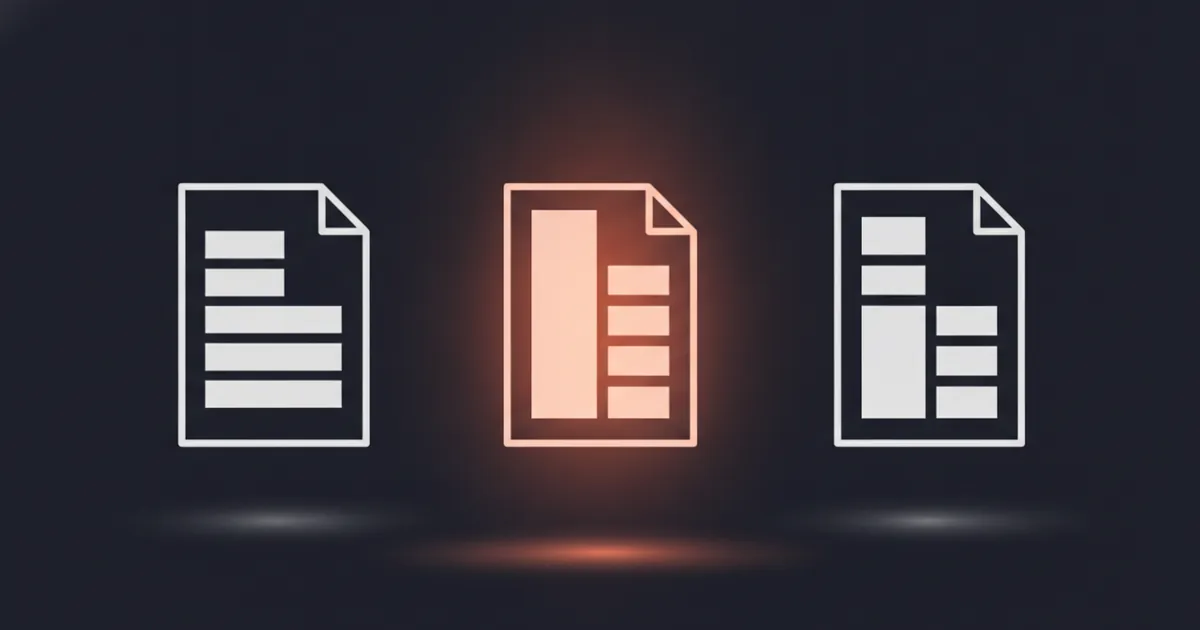
Picking the best resume format matters more than most job seekers realize. The layout you choose determines whether an ATS parses your experience correctly, whether a recruiter can find your job titles in six seconds, and whether your career story reads as credible or evasive. In 2026, three formats dominate the conversation, chronological, functional, and hybrid, and the right answer depends almost entirely on where you are in your career right now.
Why Format Choice Still Matters in an AI-Screened World
Applicant tracking systems are not going away. An estimated 97% of Fortune 500 companies use ATS software, and the adoption rate among mid-market employers has been climbing steadily since 2022. These systems parse your resume into structured fields before a human ever sees it, and how cleanly they can do that job depends largely on your layout.
Beyond the robots, LinkedIn's 2025 Global Talent Trends report found that 76% of employers now prioritize skills over degrees and job titles. That single data point is reshaping which resume format performs best for whom. Chronological still wins on raw ATS parse rates, but the hybrid format is the fastest-growing choice in 2026 precisely because it surfaces skills first without sacrificing the work history that recruiters still expect to see.
Understanding all three formats, including the one you should almost certainly avoid, is the first step.
The Three Main Resume Formats Explained
Chronological (Reverse-Chronological)
The reverse-chronological resume lists your most recent job first and works backward. It is the oldest format and still the most widely used for a simple reason: recruiters and hiring systems are optimized for it.
Structure:
- Contact information and summary
- Work experience (most recent first, with dates, employer, title, and bullet points)
- Education
- Skills
What it does well: ATS systems tested across Workday, Greenhouse, Lever, Taleo, iCIMS, and SmartRecruiters show reverse-chronological resumes averaging 97% extraction accuracy. Recruiters trained on this format can immediately see your career trajectory, your most recent title, and your tenure without hunting for it.
Where it struggles: If you have gaps longer than a few months, have changed careers completely, or are re-entering the workforce after time away, a straight chronological format forces your gaps to the surface with no context.
Best for: Candidates with a steady, relevant work history in the same field or industry. This covers the majority of job seekers, if you are not sure which format fits, start here.
Functional
The functional resume groups experience by skill area rather than by employer and date. A section called "Project Management" might contain bullet points drawn from three different jobs without ever specifying when those jobs happened.
Structure:
- Contact information and summary
- Skills or competencies sections (grouped by theme)
- Brief work history (often a stripped-down list with titles and dates, no bullets)
- Education
What it does well: In theory, it lets a career changer or someone returning from a long gap lead with capability rather than chronology.
Why it backfires in 2026: A 2025 SHRM survey found that 63% of hiring managers react negatively to functional resumes because they read as an attempt to hide gaps or inconsistencies. More critically, ATS parse rates drop 14 to 18 percentage points below chronological on every major platform tested. Systems built to read chronological data get confused when experience is grouped by theme rather than by employer. Your strongest bullets may end up in the wrong field or disappear entirely.
The verdict: Avoid functional resumes for almost any situation. The one narrow exception might be a freelancer whose entire career consisted of project-based, non-employer work, but even then the hybrid format handles this more cleanly.
Hybrid (Combination)
The hybrid resume is a reverse-chronological resume with a prominent skills section added near the top, between the summary and the work experience. It leads with your key competencies so both ATS systems and human readers see them immediately, then delivers the full chronological work history that recruiters expect.
Structure:
- Contact information and summary
- Core competencies or skills (10–15 keywords, often in a brief list)
- Work experience (reverse-chronological, with full bullets)
- Education
- Additional skills or certifications
What it does well: Hybrid resumes parse within 2–3 percentage points of pure chronological resumes across all major ATS engines. They address the skills-based hiring shift directly, 43% of businesses now name skills identification as their hiring priority, without sacrificing the work history structure that makes recruiters comfortable. If you are a career changer, the skills section can bridge your old industry and your target one before the employer even reads your job titles.
Where it requires more care: The skills section at the top must contain real, job-description-matched keywords, not vague claims like "excellent communicator." A lazy skills section wastes valuable prime real estate on the page.
Best for: Mid-career professionals with 5+ years of experience, career changers, candidates applying to roles where keyword matching is competitive, and anyone whose most relevant skills are not fully visible from job titles alone.
Which Format Is Right for Your Situation?
The honest answer is that most people should use either chronological or hybrid. Functional resumes help almost no one in the current hiring environment. Here is a practical guide:
Use chronological if:
- Your recent experience is directly relevant to the role you are targeting
- You have no significant gaps (or gaps under three months that you can address briefly in a cover letter)
- You are applying in a traditional industry, finance, law, government, healthcare, where hiring managers are accustomed to standard formats
- You are a new graduate with internship and academic experience that builds a clear picture
Use hybrid if:
- You are mid-career and want your skill set to register immediately before the recruiter reads your titles
- You are changing industries and need to reframe transferable skills before the employer sees your old job titles
- You are returning to the workforce after a caregiving break, health leave, or extended travel
- You are applying to roles where the job description is keyword-heavy and you need those keywords visible above the fold
Use functional only if:
- Nearly every career advisor and recruiter data point in 2025–2026 says to avoid it
- The single rare exception: a true independent consultant or researcher whose entire career is non-employer, project-based work, and even then, consider hybrid
ATS Formatting Rules That Apply to All Three Formats
Choosing the right format is only part of the equation. How you execute it matters just as much for ATS compatibility:
- Single-column layout. Multi-column resumes confuse most parsers, which read left to right and can mix up content from adjacent columns.
- Standard section headers. "Work Experience" parses reliably. "Where I've Been" does not. Stick to conventional labels.
- System fonts at 10–12pt. Arial, Calibri, Garamond, and Helvetica are consistently readable. Decorative fonts embedded as images are invisible to parsers.
- No tables, text boxes, or graphics. These elements are invisible to most ATS systems. Skills listed in a table may be stripped entirely.
- File format: text-selectable PDF or .docx. A scanned image saved as PDF is a blank document to an ATS.
- Consistent date formatting. Use the same format throughout: "Jan 2022 – Mar 2024" or "01/2022 – 03/2024," not a mix.
If you are applying to a specific role, compare your resume's skill keywords against the job description. Roles listed on job boards like Indeed and LinkedIn embed required skills directly into their ATS filters, if those words are not in your document, your parse score drops before a human ever reads anything.
How to Build Your Work Experience Section (For Chronological and Hybrid)
Regardless of which format you choose, the work experience section does the heaviest lifting. A few rules that consistently produce stronger results:
Lead each bullet with a strong action verb followed by impact. "Managed a team" is weak. "Led a 6-person team that reduced client onboarding time by 30% over two quarters" is concrete and searchable.
Quantify wherever honest numbers exist. Revenue figures, team sizes, time savings, error rate reductions, and customer retention rates all give a hiring manager anchors. A 2025 analysis of resume performance by Jobscan found that resumes with at least three quantified achievements per role generated 40% more recruiter callbacks than unquantified equivalents.
Keep bullets to two lines maximum. Anything longer dilutes the impact and pushes key information past the six-second skim threshold that most recruiters apply at first pass.
Tailor, do not template. A resume that mirrors the exact language from the job description, not word-for-word plagiarism, but genuine alignment, performs measurably better in both ATS scoring and recruiter read-through. For interview preparation once you land the screen, interview question guides by role can help you prepare answers that match what the job description is actually asking.
The Skills Section: What to Include and What to Cut
For hybrid resumes, the skills section near the top functions as your keyword front-load. For chronological resumes, a skills section near the bottom is still valuable but less central.
What belongs:
- Hard technical skills matched to the job description (specific software, languages, certifications, methodologies)
- Industry-specific credentials or frameworks
- Language proficiencies with level (e.g., "Spanish: professional working proficiency")
What to remove:
- "Microsoft Word" and "email". These are table stakes, not skills
- Soft skills listed as nouns ("leadership," "teamwork"), demonstrate these through your bullets instead
- Skills you cannot confidently discuss in an interview
A clean, scannable skills section of 10–15 items outperforms a bloated one of 25+ every time. Recruiters skip lists that read as keyword stuffing, and ATS systems penalize density anomalies in some configurations.
Career Situation Scenarios
Recent graduate: Chronological, with education near the top rather than the bottom. Internships, research projects, and relevant coursework fill the work history section. Add a brief skills section if the role is technical.
10-year professional applying within their field: Chronological. Your titles and tenure are your strongest asset, put them front and center.
Marketing manager pivoting to product management: Hybrid. Lead with a core competencies section that highlights skills common to both roles (user research, roadmap prioritization, stakeholder communication, data analysis). The work history section then shows context. Pairing this with a strong cover letter that explains the pivot explicitly helps close the gap.
Software engineer re-entering the market after a two-year break: Hybrid, with the skills section listing current technologies, not just historical ones. If you completed any side projects, courses, or open-source contributions during the gap, add a brief "Projects" section between skills and work history.
Senior executive: Chronological, with a two- to three-sentence executive summary replacing the standard objective statement. At the senior level, titles and tenure are the signal. A hybrid format can read as over-explaining to search committees used to reading executive bios.
A Note on Resume Length
Format and length are related. For most professionals with under 10 years of experience, one page is the default. For experienced professionals with 10–20 years of directly relevant history, two pages is standard and expected. Three pages is almost never appropriate unless you are in academia or applying for a federal position.
The hybrid format adds the skills section but should not push you to an extra page. If adding a skills section means your resume becomes two pages when one page served you before, tighten your bullets. Do not just expand the format.
Getting Your Resume in Front of More People
Format gets you through the ATS. Content gets you the interview. Once your resume is clean and well-structured, the next variable is how many relevant applications you are sending. Tracking applications, interview stages, and follow-up dates in a single system prevents the common mistake of losing momentum on promising opportunities.
OfferFlow's job tracker lets you manage your full pipeline, applications, contacts, interview stages, and documents, so the work you put into formatting your resume translates into organized, consistent outreach rather than scattered spreadsheets.
The best resume format in 2026 is not a one-size answer. It is the format that matches your career stage, presents your strongest credentials clearly, and passes the technical parsing requirements of the systems that screen it first. For most people, that is reverse-chronological. For career changers and mid-career professionals competing on skills, hybrid is now the stronger choice. Functional belongs in the past.