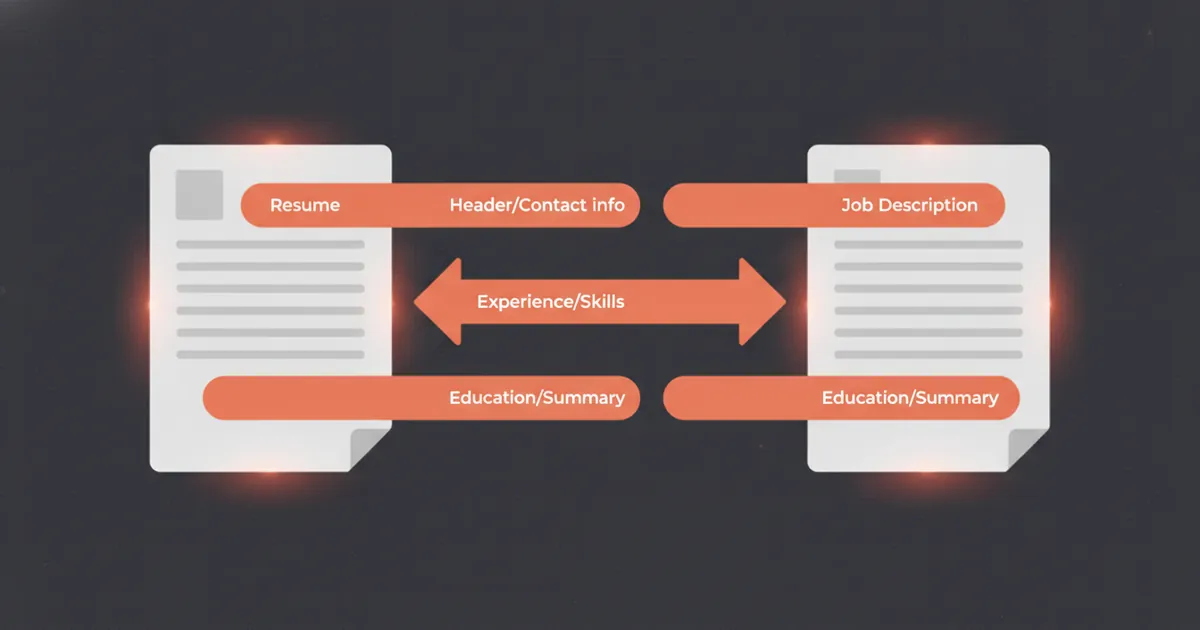
Most job seekers know they should tailor resume to job description before applying, but between reading the posting, cross-referencing your work history, and rewriting bullet points, it can easily eat an hour per application. That math kills momentum fast. This guide gives you a repeatable 20-minute process that covers every meaningful change without turning each application into a project.
Why Tailoring Is Worth the Time (and What Skipping It Actually Costs)
A 2024 analysis of over one million applications found that aligning your resume title with the job title alone increased interview rates by roughly 3.5 times. That single change takes about 30 seconds.
The broader picture is just as stark. ATS adoption among mid-size companies (50–499 employees) reached 80% by 2025, up from 66% in 2020, according to industry tracking data. Among Fortune 500 companies the figure is 99%. These systems compare your resume text against the job posting before a human ever opens the file. When 43% of applicants submit resumes that don't closely match the job description, those candidates are sorted to the bottom of the pile through ranking, not always hard rejection, but effective invisibility.
On the human side, a 2024 ResumeGo survey of 418 US hiring professionals found that nearly 80% of resumes are rejected after the first glance. Recruiters who do advance a candidate typically spend 30 seconds to one minute on the initial review. That window is too short for a recruiter to infer relevance. Your resume has to signal it explicitly.
Tailoring does that. A generic resume forces the reader to do translation work. A tailored one mirrors their language back to them, making the fit obvious in the first scan.
Before You Start: Build a Master Resume
The 20-minute method only works if you are not starting from a blank file each time. Your master resume is the full archive, every role, every bullet, every skill, going back as far as is relevant. You never send it anywhere. It is the source you pull from.
If you do not have a master resume yet, build one now and consider it a one-time investment. Every future application will be a targeted subset of it.
The 20-Minute Tailoring Process
Minutes 1–4: Extract What the Job Is Actually Asking For
Open the job description in a separate window. Read it once completely. Do not take notes on the first pass, just orient yourself. Then read it again and mark:
- The job title and any alternate title mentioned in the body
- Hard requirements (specific tools, certifications, years of experience)
- Repeated phrases (if a word appears three times in the posting, the employer cares about it)
- The language used to describe outcomes, "drive revenue," "reduce churn," "ship features", these are the verbs that signal culture and priorities
You are looking for signal words, not every noun. A 300-word posting typically contains 8–15 meaningful keywords. Focus on those.
Minutes 5–8: Adjust Your Summary and Title
Your resume header should carry the job title or a close variant. If you are applying for a Senior Product Manager role and your header reads "Product Leader," change it. ATS systems are literal. So are skimming humans.
Your professional summary (3–4 lines at the top) is prime keyword real estate. It is the first thing both ATS systems and hiring managers read. Rewrite it to surface 3–4 of the core requirements you identified in step one. Use the employer's phrasing, not your own synonym.
Example: If the posting asks for "cross-functional stakeholder management" and your summary says "working with multiple teams," the match score drops. The phrase is the match, use it.
This step alone, title and summary, covers the majority of your keyword alignment. Everything after this is refinement.
Minutes 9–14: Update Your Top Two Roles
Unless you have a highly non-linear career, your most recent two positions will do the most work. Go through the bullet points under each role and ask two questions:
- Does this bullet address anything the job description flagged?
- If yes, does it use the employer's language or mine?
Rewrite bullets where the answer to question two is "mine." You are not changing what you did. You are describing it with their vocabulary. If the posting emphasizes "data-driven decision making" and your bullet says "used metrics to improve the process," revise it to something like "applied data-driven analysis to reduce onboarding time by 22%."
Quantify wherever you can. Numbers do not need to be revised for most roles. They travel across postings. But if you have a bullet with a metric relevant to this specific role that you buried under a generic bullet, swap the order.
You do not need to rewrite every bullet. Aim for 2–4 revised bullets per role, the ones that directly address the top requirements.
Minutes 15–17: Align Your Skills Section
Skills sections are scanned by ATS keyword parsers and by recruiters looking for a quick competency check. Compare your current skills list against the hard requirements and tools named in the posting.
Three actions here:
- Add any skill the job explicitly requires that you have but did not list
- Match exact terminology, if the posting says "Salesforce CRM" and you have "Salesforce," expand it
- Remove skills that are irrelevant to this role if your list is already long (a cluttered skills section dilutes signal)
Do not add skills you do not have. ATS gaming that does not survive a 10-minute technical screen is worse than a lower match score.
For roles in tech, see OfferFlow's interview preparation resources by role if you want to cross-reference what technical interviewers actually test.
Minutes 18–20: Final Read and File Naming
Read your tailored resume once as if you are the hiring manager. Ask: does this document make it immediately obvious why this person fits this role?
Check:
- The title matches (or closely matches) the job title
- The summary mentions the role's top 3 requirements
- No unexplained jargon unique to your company appears (internal project names, proprietary systems the employer will not recognize)
- Formatting is clean, single column, standard fonts, no text boxes or tables that confuse parsers
Save the file as FirstLast-JobTitle-Company.pdf. Generic file names like resume_final_v3.pdf look careless in an ATS file list and in a recruiter's downloads folder.
The Keywords That Matter Most
Not all keywords carry equal weight. Prioritize in this order:
Job title and near-synonyms: these match you to the role category before any other filter runs.
Hard skills with specific tools or certifications: Python, Google Analytics, PMP, Salesforce. These are binary: you have them or you do not, and they are often minimum requirements.
Outcome verbs the employer uses: "built," "led," "reduced," "scaled." These reflect what the hiring team values and often reveal whether the culture is execution-oriented or relationship-oriented.
Soft skills mentioned repeatedly: if "collaboration" appears four times in a posting, it signals a culture or past team problem. Mirror it once in your summary and once in a bullet. Once is enough. Keyword stuffing reads as awkward to humans.
University of Massachusetts Amherst's career services office notes that ATS systems are often literal matchers. "project management" and "managing projects" may not score the same. Match the exact phrase where you legitimately can.
Common Mistakes That Undo Good Tailoring
Over-tailoring the skills section with hollow keywords. Adding "strategic thinking" or "results-oriented" to hit a keyword does nothing. ATS parsers deprioritize vague soft skills in favor of hard competencies. Recruiters filter them out instantly.
Changing the summary but forgetting the bullets. The summary catches the initial scan, but a recruiter who is interested will read the bullets to verify. If the bullets do not support the summary, the summary works against you.
Using a different job title than your actual title without explanation. If your official title was "Marketing Associate" but the function was identical to what the posting calls "Content Strategist," you can use both: "Content Strategist (Marketing Associate, Company Name)." Do not silently substitute. It creates a background check discrepancy.
Reformatting rather than rewriting. Moving bullet points around without changing words does not improve keyword matching. Focus on language, not layout.
Tailoring for ATS but not for the human. Some candidates optimize so heavily for keyword density that their resume reads like a job description, not a professional narrative. Write for both audiences: keywords in the right places, but sentences that flow naturally.
When to Go Deeper Than 20 Minutes
The 20-minute method is calibrated for roles where you are a solid but not exceptional match on paper, which describes most applications. For your top-choice roles, especially at companies where you have done real research and know the team's priorities, spend more:
- Read the company's recent press releases, earnings calls, or blog posts. The language executives use about their strategy often echoes in job postings and is the language leadership wants to hear back.
- Check LinkedIn profiles of people currently in the role. Their headlines and summaries often show you what skills the company actually surfaces and celebrates.
- If there is a cover letter required, the extra time pays off there more than in additional resume tweaks.
For salary benchmarking before you apply, so you go in knowing your number, OfferFlow's salary data by role and city is useful context before you decide how much time to invest in a specific application.
Tracking What You Send
One underrated part of the tailoring process is keeping a record of which version of your resume went to which company. When a recruiter calls two weeks later to discuss your application, you want to pull up exactly what they are looking at.
Keep a simple log: company name, role, date, filename, and a one-line note on the main angle you emphasized. This also tells you, over time, which framings are generating callbacks and which are not, information that sharpens your tailoring instincts faster than any advice article.
OfferFlow's job tracker is built for this, each job card stores your application details, notes, and status in one place, so nothing falls out of your head mid-search.
Putting It Into Practice
Run through this the next time you apply:
- Minutes 1–4: Extract 8–15 keywords from the posting
- Minutes 5–8: Update your title and summary
- Minutes 9–14: Revise 2–4 bullets in your top two roles
- Minutes 15–17: Sync your skills section
- Minutes 18–20: Final read and save with a proper filename
The first time through, this will take 25–30 minutes while you build the habit. By the fifth application you will be at 15. The goal is not speed for its own sake. It is making sure every minute you spend on an application is doing real work.
If you want a faster workflow for building and managing tailored resume versions, OfferFlow's resume builder lets you keep a master resume and generate targeted versions without starting from scratch each time.