Most people job search the way they clean the house when company is coming: frantically, for hours at a time, with no clear stopping point, leaving themselves exhausted and still feeling like nothing got done.
An unstructured job search produces two predictable outcomes: burnout and poor results. The irony is that working fewer, more focused hours, with the right system, consistently outperforms grinding through 10-hour job search days.
This guide gives you the complete system: what to do, when, how to measure it, and how to sustain it.
Why Unstructured Job Searching Fails
The reactive trap
Most job seekers check job boards whenever the anxiety spikes, which can be 12 times a day or once every three days. This inconsistent pattern means missing new postings during the critical 48-hour window when they're most competitive, and applying in rushed bursts that produce lower-quality applications.
The volume trap
There's a widely held belief that applying to more jobs is always better. It's not. 10 tailored, researched applications produce more interviews than 50 generic ones. The math runs in the opposite direction from what most people expect.
Quality drops with fatigue. A cover letter written in your third hour of job searching sounds tired. A recruiter can tell.
The emotional trap
Without structure, every rejection hits harder. The job search becomes an undifferentiated mass of effort and anxiety, with no way to separate "I'm working hard" from "I'm making progress." A system provides that separation.
This is especially true if you're searching after a layoff, when the emotional weight compounds the practical chaos. Getting the mental reset right before building a system makes the difference between a search that lasts 3 months and one that lasts 8.
Phase 0: Define Your Targets (Do This Before Applying to Anything)
The most time-efficient thing you can do before starting your job search is spend two hours getting clear on exactly what you're looking for.
Define your primary target
Write down:
- Role title(s): 1–3 specific job titles you're targeting
- Industry: which industry or industries are on the table
- Company type: startup, mid-size, enterprise, nonprofit: what fits you
- Geography: remote, hybrid, specific cities, and what you'll actually accept vs. prefer
- Company stage: early-stage, growth, public. Matters for culture and risk tolerance
Set your salary floor
Know your walk-away number before you start. The worst time to figure this out is when you have an offer in hand and 24 hours to decide. Write the floor down.
Build a target company list
Before posting a single application, identify 15–25 companies you'd genuinely want to work for. Research them enough that you could write a tailored cover letter in 15 minutes. These become your highest-priority applications, the ones you put the most effort into.
This phase eliminates the decision fatigue that slows down execution. "Should I apply to this?" becomes a quick yes/no against your defined criteria.
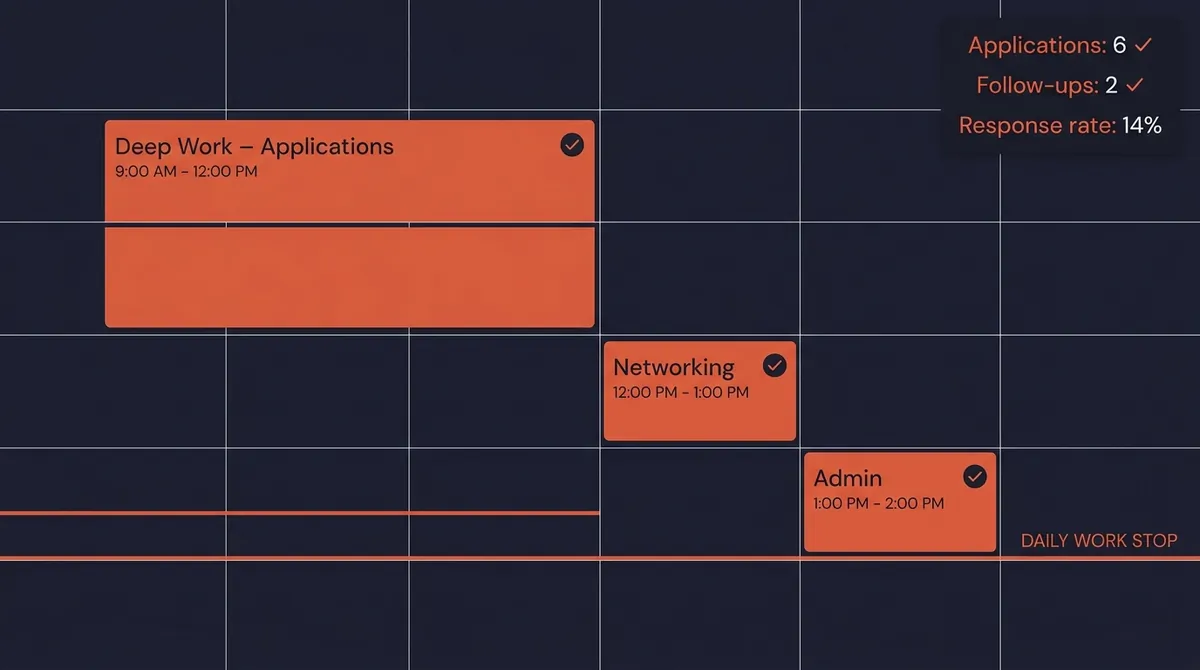
The Daily Schedule: 5 Focused Hours
The research on productivity, not just in job searching but in knowledge work generally, points consistently to 4–6 hours as the range where quality work happens. After 6 hours, output degrades faster than hours accumulate.
Sample daily schedule
9:00–9:15 | Morning setup Review your applications tracker. What follow-ups are due today? Did anything come in overnight? Write your goal for the day: "Submit 4 tailored applications and send 2 follow-ups."
9:15–11:15 | Deep work block This is your highest-quality time. Use it for researching target companies and writing tailored applications. Don't check email during this block.
11:15–11:45 | Networking and communication Respond to recruiter messages, send scheduled follow-ups, make LinkedIn connection requests with a brief note, follow up on informational interview requests.
11:45–12:30 | Lunch (mandatory) A real break. Not lunch while scrolling job boards.
12:30–1:30 | Secondary applications or interview prep If you have interviews coming up, use this block. Otherwise, additional applications with slightly less intensive research.
1:30–2:00 | Administrative close Update your tracker. Log all activity. Set follow-up dates. Organize documents sent today. Write tomorrow's three priorities.
2:00 | Stop.
Why the hard stop matters
Evening job searching produces anxiety, disrupts sleep, and doesn't improve results. Your brain needs recovery time to function well the next day. The job seekers who burn out and produce increasingly poor applications, sending worse and worse cover letters, spacing out on interviews, are typically the ones with no stopping time.
A 5-hour focused job search beats an 11-hour anxious one, every time.
The Weekly Rhythm
Daily structure keeps you executing. Weekly structure keeps you improving.
Monday: Strategy review
Look at last week's metrics. What worked? What didn't? Plan the week: which target companies to prioritize, what networking outreach to send, any interviews to prepare for.
Tuesday–Thursday: Execution
Full application days. This is your highest-output period. Protect these blocks from other obligations where possible.
Friday: Admin and reflection
Update your tracker for all of last week's activity. Calculate your weekly metrics. Review your pipeline, what moved, what's stalled? Send any pending follow-ups. Log what you learned this week.
Friday afternoon: mentally off. Non-negotiable.
Weekends
At least one full day without any job search activity. This isn't optional if you're running a multi-week or multi-month search. Mental resilience is a resource you can deplete, protect it.
The Metrics That Tell You If You're on Track
Feelings are unreliable guides in a job search. Track these numbers instead.
Application-to-response rate
(Screening calls + Interview invites) / Total applications sent
- Below 5%: You have a resume, formatting, or targeting problem. Stop adding volume. Fix the input.
- 5–10%: Decent but room to improve. Examine whether you're tailoring effectively and following up consistently.
- 10–20%: Healthy. Focus on increasing quality volume.
- Above 20%: Excellent targeting. Scale carefully.
Weekly application volume
The right number depends on your situation and the role type you're targeting. For most active job seekers, 10–20 quality applications per week is the target range. Fewer than 5 suggests a volume problem; more than 25 usually means quality is declining.
Pipeline stage distribution
Look at your kanban board. Where are cards clustering? Cards stuck in "Applied" for 3+ weeks indicate a follow-up gap. Cards not advancing past "Screening" indicate a conversion issue. The distribution is diagnostic.
Time-to-response by source
Which job board or source generates the fastest responses? Over 4–6 weeks, patterns emerge. Double down on what works, reduce time on what doesn't.
The Right Tools (Without Overcomplicating It)
What you actually need
- Job tracker: One source of truth. Spreadsheet or dedicated app. Non-optional.
- Calendar: Block your schedule. Schedule follow-up reminders as actual calendar events.
- Job alerts: Configured for daily or real-time delivery on LinkedIn, Indeed, and 1–2 niche boards.
- Chrome extension: To capture job descriptions before they expire.
What to avoid
Too many tools. Switching between 5 different apps creates friction and fragments your data. Pick a primary system and stick with it.
Manual job post saving. If you're bookmarking URLs or copying links, half of them will be dead within 3 weeks. You need the job description text, not just the link.
OfferFlow as a central hub
OfferFlow consolidates the key elements: a kanban pipeline for your applications, contact management for every recruiter you interact with, document storage so you always know which resume version was sent, follow-up reminders, and a Chrome extension to capture jobs from any board. It's the closest thing to a dedicated system purpose-built for this workflow. Free to start.
How to Avoid Burnout During a Long Search
A 3-month job search with consistent effort is sustainable. A 3-month search with no structure often derails at week 5.
Non-negotiable daily movement. Exercise is not a bonus in a job search. It's infrastructure. Anxiety is physical. Moving your body is one of the most effective tools for managing it.
One meaningful non-job-search project. Identity doesn't come only from employment. Keep one project, a personal build, volunteer work, a course, a creative pursuit, that gives you a sense of progress independent of your job search outcomes.
Social contact. Isolation amplifies everything negative. Even one real conversation with someone who cares about you per day changes the experience of a hard search period.
Track process, not just outcomes. You can't control whether you receive an offer this week. You can control applications sent, follow-ups made, networking touches. Celebrate process metrics when outcome metrics are slow.
The Mindset Shift That Changes Everything
The job seekers who find work fastest are not the ones who are most desperate or work the most hours. They're the ones who approach the search with the same rigor they'd apply to their best professional work: clear goals, consistent systems, data-driven iteration, and the discipline to stop when their best work is done for the day.
Your job search is a project. Treat it like one.
Define your targets. Build your daily and weekly rhythms. Track your metrics. Fix what's not working. Protect your energy.
The system doesn't guarantee an offer next week. It guarantees that every week of searching is as efficient as it can be, and that you'll still be sharp and resilient when the right opportunity appears.