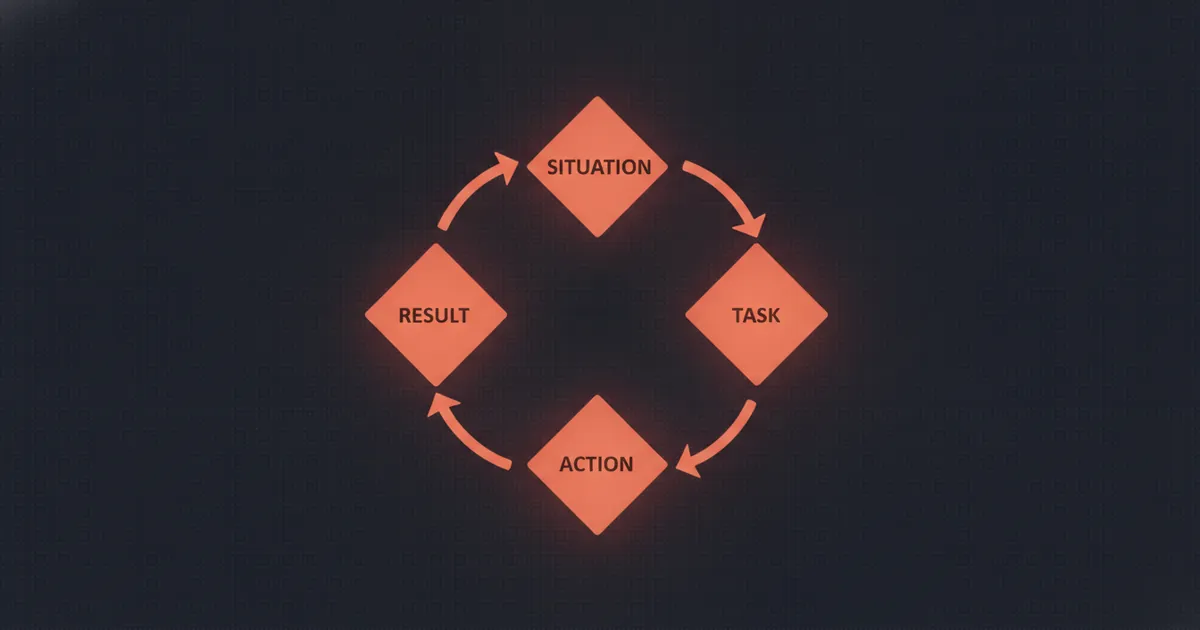
Behavioral interviews trip up candidates who prep for the wrong thing. Most people memorize generic talking points about "being a team player" or "working well under pressure". Then freeze when a hiring manager says, "Tell me about a time you had a conflict with a coworker." The STAR method interview framework exists precisely to fix that. It gives you a reusable structure that turns messy, hard-to-tell career stories into crisp, credible evidence of how you actually work.
This guide explains the framework in full, walks through each component with examples, identifies the mistakes that kill otherwise strong answers, and gives you a preparation system you can use before any interview.
What the STAR Method Is (and Why Employers Use It)
STAR stands for Situation, Task, Action, Result. It's a response format for behavioral interview questions, the kind that start with "Tell me about a time…" or "Describe a situation where…"
Employers ask behavioral questions because past behavior is the single strongest predictor of future job performance. Research published in the Journal of Business Research found that structured behavioral interviews have a validity coefficient of roughly 0.42, significantly outperforming unstructured interviews, resume reviews, or assessments based on years of experience alone. When an interviewer asks you how you handled a difficult deadline, they're not making conversation. They're running a predictive model.
The STAR format helps both sides. For the interviewer, it produces structured, comparable answers that cut through rehearsed generalities. For you, it prevents the two failure modes that tank behavioral answers: rambling with no point, and speaking in vague platitudes that could apply to anyone.
According to a survey by Glassdoor, 88% of hiring managers say well-prepared candidates stand out noticeably. DDI, a behavioral interviewing firm that trains interviewers at Fortune 500 companies, reports that roughly 72% of organizations now use structured interviews as standard practice. When that many interviewers are trained to evaluate STAR-shaped answers, showing up without that structure puts you at a disadvantage before you open your mouth.
Breaking Down Each Component
Situation
Set the scene in one to three sentences. The goal is context, enough for the interviewer to understand the stakes, not a full project history. Think: what was the environment, what was going wrong or needed to change, and roughly when?
Weak: "I was working at my last job and we had a problem with a client."
Strong: "At my previous company, we had a mid-market SaaS client who was 90 days into a six-month onboarding and threatening to cancel because their team hadn't fully adopted the product."
The second version immediately tells the interviewer: B2B environment, high-stakes retention situation, a real deadline in play.
One practical rule: keep the Situation to under 20% of your total answer. Many candidates spend three minutes here and run out of time before reaching what actually matters. What they did.
Task
Task clarifies your specific role in the situation. This is where you distinguish between what the team was dealing with and what you personally were responsible for. It matters because interviewers are evaluating your judgment and initiative, not the general difficulty of the circumstances.
Weak: "I was on the team handling it."
Strong: "I was the account manager assigned to the account, and my manager made it clear the renewal decision would depend on what happened in the next 30 days."
If you skip Task or blur it into Situation, the interviewer can't tell how much agency you actually had. That ambiguity reads as deflection.
Action
This is the heart of the answer. Describe the specific steps you took, not what the team did, not what you suggested someone else do, not what eventually happened. What did you decide, initiate, and execute?
The most common STAR method interview mistake happens here. Candidates use vague action language: "I took ownership," "I facilitated communication," "I helped resolve the issue." These phrases are so general they're meaningless. Every candidate says some version of them.
Replace vague verbs with specific behaviors:
- "I took ownership" → "I blocked two hours every Monday to audit the client's usage data and identify which features they hadn't touched"
- "I facilitated communication" → "I set up biweekly calls between their IT lead and our implementation engineer, wrote the agenda each time, and followed up with written summaries"
- "I helped resolve the issue" → "I built a custom onboarding checklist in our project management tool, mapped it to their internal workflow, and ran a 45-minute walkthrough with their admin team"
Shoot for two to four concrete action steps. If you only took one action, the story may be too thin. If you're describing seven actions, you're probably narrating the whole project instead of the pivotal choices.
A word on pronouns: use "I," not "we." Even on collaborative projects, the interviewer needs to understand what you contributed. You can acknowledge the team, "I coordinated with the engineering lead", without attributing your work to the group.
Result
Close with what happened. Results should be measurable whenever possible. Numbers give interviewers something concrete to anchor their assessment, and they signal that you actually tracked outcomes rather than just doing tasks.
Weak: "The client ended up staying and things improved."
Strong: "The client renewed at their current tier, and in the post-renewal survey they rated onboarding satisfaction 4.6 out of 5, up from 2.1 at the 90-day mark. My manager used the case as a template for our high-risk account playbook."
If you genuinely don't have a number (some outcomes are qualitative), lean on concrete markers: "The project shipped two weeks early," "I received a written commendation," "The client requested I be assigned to their expansion project."
Also address secondary results when they're meaningful: what you learned, how it changed your approach, whether it influenced team process. This shows self-awareness, which is a signal many interviewers weigh heavily for roles requiring judgment.
Building Your Story Bank
One well-prepared STAR story can answer many different questions, if you choose the right stories. Career coaches at Yale's Office of Career Strategy recommend preparing six to eight versatile stories before any interview cycle. That sounds like a lot; in practice, it's about an afternoon of work.
Here's how to approach it:
Step 1: Identify high-signal themes. Most behavioral questions probe a small set of competencies: problem-solving, conflict resolution, leadership/influence, failure/learning, collaboration, and handling pressure or ambiguity. Map one to two stories per theme.
Step 2: Choose stories with texture. The best stories involve real difficulty. A constraint you had to work around, a stakeholder who pushed back, a plan that partially failed. Smooth success stories feel rehearsed. Stories with friction feel true.
Step 3: Write each story in STAR format before you speak it. The act of writing forces you to find the specific actions and results you'd otherwise skip over. Aim for about 150–200 words per written story. That translates to roughly 90–120 seconds when spoken, which is the target length for most behavioral answers.
Step 4: Practice out loud, not in your head. The gap between "I know what I want to say" and "I can say it fluently under pressure" is only closed by speaking the words. Record yourself once per story. You'll immediately hear where you're being vague.
The Most Common STAR Method Mistakes
Over-indexing on Situation. You walk the interviewer through a five-minute project backstory and have 30 seconds left for Action and Result. Interviewers are judging you on what you did, not on how complicated the situation was.
Burying the Action in "we" language. "We decided to pivot the strategy" is meaningless. Who decided? What was the deciding factor? What did you specifically advocate for?
Results that evaporate. "It worked out well" is the most common result statement in behavioral interviews, and it communicates nothing. Even if you don't have a hard metric, you can describe a concrete outcome: the deadline was met, the relationship was preserved, the new process was adopted by the team.
Picking irrelevant stories. A candidate interviewing for a product management role who tells a customer service story about de-escalating an upset caller isn't matching signal to audience. Review the job description before every interview and select stories that demonstrate the competencies it explicitly asks for.
Memorizing a script instead of a structure. When you memorize word-for-word, any interruption, a follow-up question, a technical glitch, a distraction, breaks your flow. Memorize the four beats: Situation, Task, Action, Result. Know your key details (the numbers, the timeline, the outcome). The exact words should come naturally in the moment.
Adapting STAR for Different Question Types
Not every behavioral question fits the same template. Here's how to adjust:
Failure questions ("Tell me about a time you made a mistake"): The Result section should focus on what you learned and what you changed afterward. Interviewers know you're not perfect; they want evidence that you process setbacks productively rather than defending against them.
Leadership questions ("Describe a time you led a project without formal authority"): Emphasize the Action steps that involved influencing others, how you built buy-in, how you handled disagreement, how you kept momentum without a title.
Conflict questions ("Tell me about a time you disagreed with your manager"): Be specific and professional. Avoid making the other party sound unreasonable. Focus on how you raised your concern respectfully, what data or reasoning you brought to the conversation, and how the situation resolved, even if you didn't "win."
Ambiguity questions ("Tell me about a time you had to make a decision with incomplete information"): The Action section here should walk through how you identified what you didn't know, how you scoped the decision, and what you did to reduce uncertainty before committing to a direction.
Practicing with Real Questions
Before any interview, pull the job description and identify three to five competencies that appear most prominently, look for words like "cross-functional collaboration," "data-driven decisions," "customer focus," or "ownership." Then map those to your story bank and make sure you have a STAR answer ready for each.
Some of the most frequently asked behavioral questions across industries, based on aggregated data from Indeed and Yale's career resources:
- "Tell me about a time you had to meet a tight deadline."
- "Describe a situation where you had to persuade someone who disagreed with you."
- "Tell me about a time you failed at something. What did you do?"
- "Give me an example of a time you had to juggle multiple priorities."
- "Tell me about a time you took initiative without being asked."
Each of those maps neatly to a STAR story. If you've written out six to eight stories in advance, most of those questions are already covered.
For role-specific behavioral questions, especially if you're preparing for a particular job title, OfferFlow's interview question library covers common questions by role and includes response guidance you can use to sharpen your preparation.
Using STAR Beyond the Interview Room
The framework isn't only useful in interviews. STAR thinking helps you document accomplishments for your resume ("Reduced onboarding time by 30% by redesigning the new-hire checklist, Action/Result"), write compelling cover letters, and prepare for performance reviews. The discipline of translating "stuff I did" into structured, outcome-linked narratives is a transferable professional skill.
For help structuring those accomplishments into a resume that surfaces them clearly, OfferFlow's resume tools let you build achievement-focused bullet points and tailor them to specific job descriptions.
A Note on Authenticity
The STAR method is a communication framework, not a fabrication tool. Interviewers who use it regularly are trained to probe. "What specifically did you say in that conversation?" "How did you measure that outcome?" "What would you do differently?" A polished but invented story collapses under follow-up. Real stories with rough edges survive.
The best candidates don't pick the stories where everything went perfectly. They pick stories where something was genuinely hard, where they had to make a real judgment call, and where the outcome, good or mixed, taught them something. That combination of specificity and honesty is what distinguishes a memorable answer from a forgettable one.
If you're preparing for a specific type of role, reviewing common interview questions for your target position before you finalize your story bank ensures you're not missing the competencies that matter most for that job. Understanding salary expectations for your role and location before the interview also puts you in a stronger position for the compensation conversation that follows a successful behavioral round.
The STAR method interview framework works because it forces specificity, and in interviews, specificity is what trust is built on. Prepare your stories, practice them out loud, and match them to the job in front of you. That's the whole system.