Knowing what hiring managers look at on a resume matters more than almost any other piece of job-search advice, because it determines whether your application survives the first cut. The answer is narrower than most candidates expect, which is actually good news: once you know where eyes land, you can put the right things there.
The 7-Second Threshold Is Real: Here Is What It Means
TheLadders ran an eye-tracking study, the most frequently cited piece of primary research on this question, by attaching eye-tracking hardware to recruiters while they reviewed resumes. The average initial screening time came in at 7.4 seconds. A separate 2025 study by InterviewPal measured 4,289 anonymized resume reviews from 312 recruiters and hiring managers across the U.S. and found similar patterns: most "no" decisions happen before the one-minute mark.
Seven seconds does not mean a recruiter reads your resume in seven seconds and moves on. It means they form a directional judgment, pass or fail, in that window. If the first pass generates a "maybe," the resume gets a second, longer look. That second look is where your details matter. The goal of your resume's first impression is simply to survive into that second phase.
What happens in those seven seconds? Eye-tracking data consistently shows recruiters scanning six specific data points in roughly this order:
- Name
- Current or most recent job title
- Current or most recent employer
- Employment dates (tenure signals)
- Previous job title
- Education
That is the list. Not your objective statement. Not your skills section header. Not the decorative line you added between sections. Six data points, and fit-or-no-fit decisions hinge on them.
Where Eyes Actually Go: The F-Pattern and E-Pattern
Eye-tracking research, including TheLadders' updated study, shows that recruiters read resumes the same way they read dense web pages, in an F-pattern or E-pattern. Their gaze sweeps left-to-right across the top, then drops and moves left-to-right again, with diminishing rightward travel on each subsequent pass.
What this means practically:
- Left-aligned text gets read; right-aligned text gets skimmed or skipped. Dates shoved to the far right margin are less likely to register on the first pass than job titles anchored to the left.
- The top third of the page is prime real estate. Whatever appears in the first eight to ten lines receives the most fixation time. Anything below the fold, roughly below the first job entry on a one-page resume, gets progressively less attention.
- Bold text and headers function as anchors. Recruiters jump between section headers and bold job titles, using them to navigate. If your section headers are faint or oddly named ("Professional Journey" instead of "Experience"), navigation slows and the eye wanders off.
The practical implication: your most compelling credential, the title, employer, or achievement that makes you obviously qualified, needs to be in the top third, and it needs to be immediately parseable.
What Hiring Managers Are Actually Looking For
Eye tracking tells you where they look; surveys tell you what they are looking for when they get there.
Work Experience, Heavily Weighted
Research from multiple recruiter surveys shows work experience consistently ranks as the most scrutinized section. Hiring managers are pattern-matching: does this person's history map onto the role I am trying to fill? They are looking at job titles (do they signal relevant seniority?), employer names (do the companies carry industry credibility?), and tenure (are there patterns of short stints?).
Fifty percent of hiring managers say frequent job changes make them hesitant to advance a candidate, according to ResumeGenius's 2025 Unfiltered Hiring Insights survey. That does not mean one short tenure disqualifies you, but a pattern, three companies in two years without an obvious explanation, trips a mental flag during that initial seven-second scan.
Quantified Achievements, Not Job Descriptions
Once a recruiter decides to look more closely, they are hunting for evidence that you actually moved the needle. Resumes that include hard metrics, percentages, dollar amounts, headcounts, timeframes, perform meaningfully better in studies measuring callback rates. The difference is not subtle: research consistently shows that candidates who quantify results are significantly more likely to reach an interview than those who list responsibilities without outcomes.
The most common mistake: writing a job description in bullet form rather than an achievement record. "Managed social media accounts" tells a hiring manager what you were assigned to do. "Grew LinkedIn following from 4,200 to 18,000 in 11 months, increasing inbound leads by 34%" tells them what happened because of you. The second version is what survives a seven-second scan and earns a closer read.
Skills, But Context Matters
Forty-one percent of recruiters report looking at the skills section first, according to aggregated recruiter survey data. However, skills listed without context, a bulleted column of tools and technologies, are some of the lowest-value content on a resume. Hiring managers know candidates inflate skills sections. What they trust is a skill demonstrated inside a work experience bullet.
List skills, yes, but treat the standalone skills section as a quick-reference inventory, not a substitute for showing the skill in action. If Python is central to the role, mention it in the skills section and demonstrate it inside a work experience bullet with a concrete output.
The Education Section Gets Less Attention Than You Think
For candidates more than a few years into their careers, education gets a glance. Hiring managers are confirming that a degree exists (or noting its absence, depending on the role), checking the institution, and moving on. Unless you are a recent graduate, education should not occupy prime screen real estate. It belongs near the bottom of the page.
Recent graduates are the exception. If your experience section is thin, your education section does more work, relevant coursework, GPA if above 3.5, honors, and student projects can all serve as proxies for professional track record.
Before a Human Sees It: The ATS Reality
A significant share of resumes never reach the seven-second human scan. Most mid-to-large employers use applicant tracking systems (ATS) to manage application volume. These systems parse your resume into structured fields, name, contact info, employment history, skills, education, before routing it to a human reviewer.
The most common reasons resumes fail to parse correctly have nothing to do with your qualifications:
- Tables and columns confuse many ATS parsers. What looks like a clean two-column layout on screen can appear as scrambled text when machine-read.
- Headers and footers are often ignored by parsers. Never put contact information or page numbers in the document header/footer field.
- Non-standard fonts and graphics can cause parsing errors on older ATS platforms.
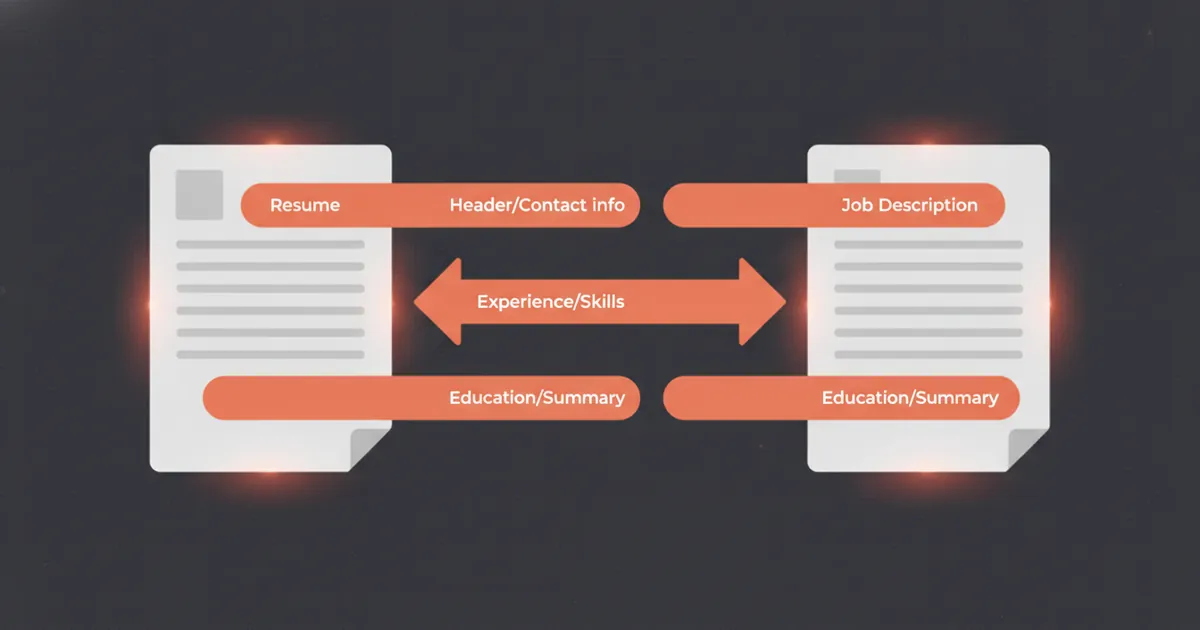
- Keyword misalignment is the most avoidable issue. If the job description says "account executive" and your resume says "sales representative," some systems treat these as different roles.
The fix is not to game the system. It is to write clearly and tailor your language to the specific job posting. Mirror the exact phrasing from the job description where accurate. If the posting lists "project management" and you have that experience, use that phrase, not a synonym.
For a role-specific starting point, OfferFlow's resume examples by role show how to phrase experience for common job titles in ways that parse well and read naturally.
The Red Flags That Trigger Immediate Rejection
Hiring managers are faster at identifying reasons to pass than reasons to advance. Certain patterns end the review before the seven seconds are up.
Formatting chaos. Inconsistent fonts, misaligned bullet points, and walls of dense text signal low attention to detail. Seventy-three percent of hiring managers in a Qureos survey said they reject candidates due to poor resume formatting. This is a proxy judgment: if you cannot organize a one-page document, what does that suggest about your work output?
Employment gaps without framing. A gap is not automatically disqualifying, only 9% of hiring managers call it an outright dealbreaker in the 2025 ResumeGenius survey. But an unexplained gap during the seven-second scan creates a question that interrupts the reading flow. A brief parenthetical ("career break. Caregiver, 2023–2024") takes three seconds to add and removes the cognitive speed bump.
Generic objective statements. "Seeking a challenging position where I can leverage my skills" is one of the fastest ways to signal that you sent the same resume to 200 employers. Hiring managers recognize it instantly. Use a concise summary that names the role, the relevant experience, and one specific value proposition, or skip the summary entirely.
Obvious AI generation. More than half of hiring managers in the 2025 ResumeGenius survey said they have reservations about AI-generated resumes, with 20% calling it a potential dealbreaker. The tell is usually formulaic sentence structure and suspiciously uniform bullet lengths. Use AI tools to assist, to identify gaps, suggest phrasing, or check for keyword alignment, but write the substance yourself.
Length mismatches. A new graduate with a three-page resume and a 15-year veteran with a single half-page resume both create friction. Conventional guidance, one page per decade of experience, with a hard cap of two pages for most roles, exists because it reflects how much hiring managers expect to process.
What Happens After the Initial Screen
If your resume passes the first cut, it enters a longer review, typically conducted by the hiring manager, not an initial screener. At this stage, the questions shift:
- Does the progression make sense? Are the titles and responsibilities moving in a plausible career direction?
- Are the claims credible? Big metrics attract scrutiny. "Increased revenue by 400%" in a three-person startup is plausible; the same claim at a regional logistics firm invites skepticism.
- Is there relevant specificity? Hiring managers know their industry. Vague bullets ("worked with cross-functional teams") tell them nothing. Specific ones ("coordinated with procurement and legal to reduce vendor contract cycle time from 45 to 18 days") tell them you understand how the work actually happens.
This is also where LinkedIn enters the picture. A CareerBuilder study found that 70% of employers use social media to screen candidates before interviewing them. Hiring managers frequently check whether your LinkedIn profile is consistent with what your resume claims. Mismatches, different dates, missing jobs, a summary that contradicts your resume's framing, create trust problems that no cover letter can repair.
Structuring Your Resume Around What Gets Read
Given everything above, a resume that performs well in the current hiring environment has a predictable structure:
Header: Name, phone, email, LinkedIn URL, city/state. No photo, no date of birth, no home address beyond city. Left-aligned or centered, never split across columns that might confuse an ATS parser.
Summary (optional but useful): Two to three sentences. Role-specific, experience-forward, no filler adjectives. Skip it if you cannot make it specific.
Experience: Reverse-chronological. Each entry shows company name, your title, dates, and three to five bullets anchored in achievements with metrics where possible. The first bullet of each entry carries the most weight, make it your best result for that role.
Skills: A clean, scannable list grouped by category if you have more than eight items. Only list what you can speak to in an interview.
Education: Degree, institution, graduation year. Honors if recent. Coursework only if directly relevant and you are early-career.
For tailoring to a specific role, tools like OfferFlow's AI resume builder can help you map your experience against a job description and identify where you are under-selling relevant work.
The Interview Gap: When Resumes Succeed Too Well
One overlooked truth: a resume that gets you an interview can still create problems if it over-promises. Hiring managers who feel misled between the resume and the interview, because the resume implied more senior experience, or claimed skills that surface as shallow in conversation, rate the candidate lower than if the resume had simply been accurate.
The goal is not to write the most impressive-sounding resume. It is to write the most accurate resume that also leads with your strongest relevant evidence. Accuracy and selectivity, not inflation.
If you are preparing for interviews after getting the callback, OfferFlow's interview question guides by role walk through the questions hiring managers actually ask, so you can confirm the resume claims hold up under scrutiny.
Getting the Basics Right Before Everything Else
Most advice about what hiring managers look at on a resume focuses on differentiation. How to stand out. But the data suggests a prior problem: most resumes do not clear the baseline. They fail the seven-second scan because the six data points are not surfaced clearly, or they fail the ATS pass because of formatting issues, or they fail the closer read because bullets describe duties rather than results.
Fix the basics first. Clear hierarchy, left-aligned job titles, achievement-oriented bullets with at least some metrics, and language that mirrors the job description. These are not optimizations. They are table stakes.
Once the basics are solid, tailoring matters enormously. An 83% higher likelihood of moving forward for candidates who tailor their resume, that figure from recruiter survey data, reflects a simple reality: hiring managers are always asking "is this person interested in this specific role, or are they mass-applying?" Tailoring is how you answer that question before the interview.
Start building a tailored, ATS-ready resume at OfferFlow. The platform helps you structure experience bullets, align language to job descriptions, and track which version of your resume you sent to each application.