You've made it past the resume screen and the recruiter call. The interview is Tuesday. Most mid-senior candidates spend the weekend cramming on the company, reading their blog, memorizing their last earnings call, building elaborate "key insights" docs. Then they walk into the interview and stumble on the question every hiring manager asks: "Tell me about a time you..."
The biggest gap in mid-senior interview prep isn't company knowledge. It's storytelling. You've done the work. You probably have 20 strong stories from your career. But under pressure, you can't pull them out cleanly. You blank. You ramble. You give a 5-minute answer when 90 seconds would have landed.
This guide is the 48-hour framework that fixes that. It's built around three things: a story bank, a focused company-research pass, and a calm execution plan.
Re-Read the Job Description (Not Just Once)
Start with the job description. Most candidates read it once before applying and never look at it again.
Print it out or open a clean copy. Highlight every requirement, every bullet under "responsibilities," every "you have" line. From that highlight set, pull out the three to five things that are clearly load-bearing, the skills they'll definitely probe in the interview.
For each one, ask yourself: "What's the most concrete win I can tell about doing this?" That's your story bank for this specific interview.
If you can't think of one for a given requirement, that's a flag. Either build the story now (drafting from a less-prominent experience), or be ready to acknowledge the gap and pivot to adjacent skills.
The Story Bank: The Single Most Underrated Prep
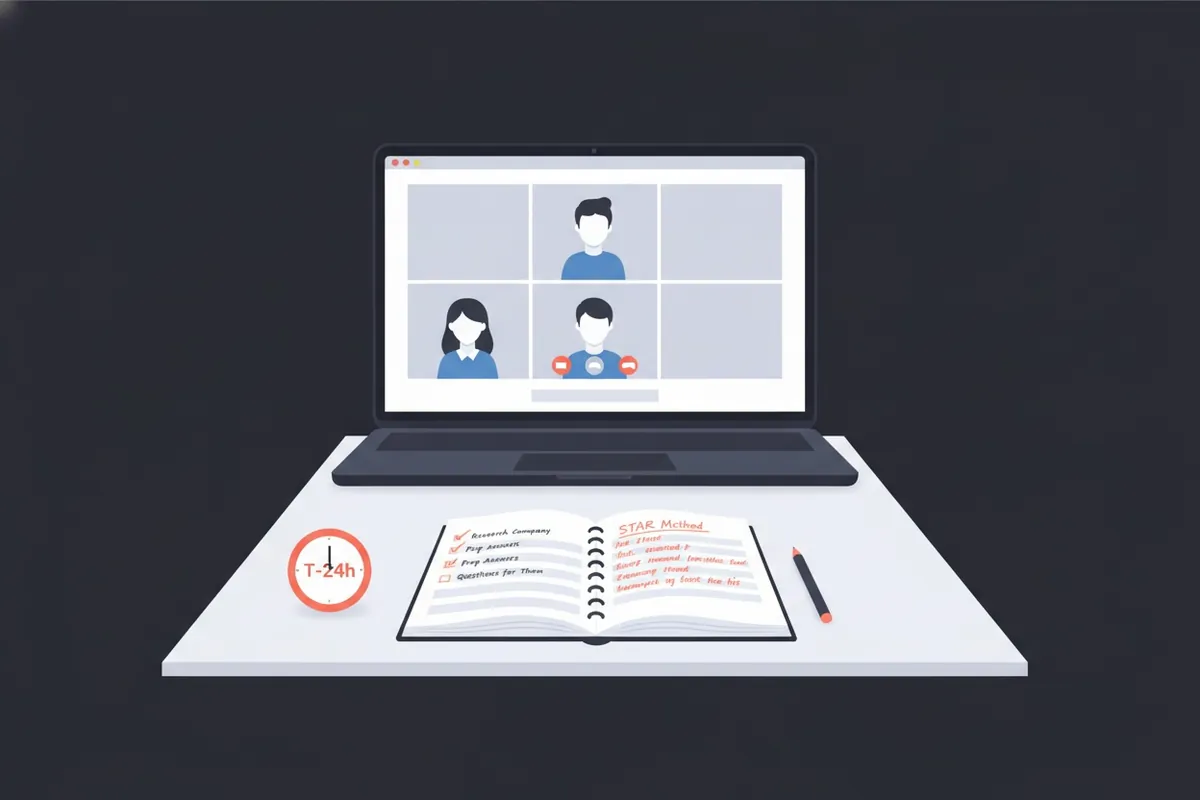
Build six to ten STAR-formatted stories from the last three years. STAR is:
- Situation: the context, briefly (1 sentence)
- Task: what you were responsible for (1 sentence)
- Action: what you actually did (2–4 sentences, the heart of the story)
- Result: what changed, with a metric (1 sentence)
Each story should run 90 seconds out loud. Practice them. Time yourself.
The unfair advantage of a story bank: one story can answer multiple question types. A story about leading a difficult product launch can answer:
- "Tell me about a time you led without authority"
- "Walk me through a project you're proud of"
- "How do you handle stakeholder conflict?"
- "Describe a high-pressure situation"
When the interviewer asks the question, your brain shouldn't be inventing a story. It should be selecting which prepared story applies. The selection takes 2 seconds. The story plays in 90.
Research the Company (Smart, Not Excessive)
Limit company research to 60 minutes. Past that, you're procrastinating.
Useful sources:
- Most recent earnings call or funding announcement: tells you what's actually on leadership's mind right now
- Hiring manager's LinkedIn: pin their last three posts in your mind, scan their work history
- Glassdoor interview reviews filtered to your team or role. Gives you specific question patterns
- Their product: actually use it for 15 minutes, not just read about it
The output of this hour should be one specific question you can ask them. Not "what's the culture like?" Not "what does success look like in this role?" One specific question that proves you read something they wrote.
Example: "Your CEO mentioned in the Q3 earnings call that the European expansion is the top priority for 2026. How is the product team organized to support that. Is there a dedicated EMEA squad, or is it cross-functional?"
This question signals: I read, I synthesized, I'm already thinking about my contribution.
Research the Interviewers
Look up each interviewer on LinkedIn:
- Their role and tenure at the company
- Tech stack or domain mentions in their experience
- Anything they've written or spoken about publicly
You don't need to memorize their bios. You just need enough context to skip the "what does your day look like?" small talk and get into substantive conversation faster.
If you spot a shared connection, same prior company, same university, similar projects, file it away. A natural mention midway through the interview ("I noticed you worked at X. I overlapped with Y who was on your team") often builds genuine rapport.
12 Questions to Expect (Mid-Senior)
The questions cluster into predictable categories. Prepare answers for all twelve and you'll cover 90% of what gets asked:
- "Walk me through your resume." Your 90-second career arc. Not a chronology, a narrative. Where you started, what changed you, where you are now, why this role.
- "Tell me about a time you led without authority." A story bank story about cross-functional influence.
- "Describe a project that failed and what you learned." Be specific about the failure. Take real responsibility. Land on a concrete lesson applied since.
- "Why are you leaving your current role?" Forward-looking, not backward. "I'm ready for X opportunity", never "I hate Y."
- "What's your salary expectation?" See how to negotiate a job offer for the playbook.
- "Why this company?" This is the one company-research question. Specific reasons only.
- "Tell me about a conflict with a stakeholder." Story about navigating disagreement, not story about being right.
- "What's the hardest problem you've solved?" Pick the one that maps closest to the job's requirements.
- "How would you approach [hypothetical scenario]?" Don't jump to a solution. Talk through how you'd diagnose, who you'd talk to, what data you'd want.
- "What questions do you have for us?" Always have 3+ ready. Drop down to one when time is short. Specific, not generic.
- "Where do you see yourself in 3 years?" Tied to growth in the function, not "your job."
- "Why should we hire you over other candidates?" Three sentences. Specific to the role, not generic.
The 48-Hour Prep Schedule
- T-48 hours: Re-read JD, list story gaps, draft 6–8 STAR stories, list questions to expect
- T-24 hours: Mock interview out loud (record yourself if possible), refine stories that ran over 90 seconds
- T-2 hours: Review interviewers' LinkedIn, settle on one specific question per interviewer
- T-30 minutes: Water, not coffee. Three slow breaths. Light review of your top three stories.
That's it. Resist the urge to keep cramming. Past the 24-hour mark, marginal returns drop.
Day-Of Tactics
For remote interviews:
- Camera angle slightly above eye level
- One soft light source in front of you (not behind)
- Audio test 15 minutes before, earbuds usually beat laptop speakers
- Have your resume and the JD open on a second device, not on screen
For all interviews:
- Slow your speech down by ~10%. Most candidates rush under stress.
- Pause for 2–3 seconds before answering hard questions. Looks confident, gives you time to pick the right story.
- It's okay to say "let me think about that for a second", better than filler.
- Take notes. Looks engaged. Helps with the thank-you email afterward.
After the Interview
Within 24 hours, send a thank-you email to each interviewer. Short, specific, references something they said. See how to follow up on a job application for the templates.
Log notes while they're fresh: what went well, what didn't, what questions they asked, what surprised you. These notes are gold for the next round of interviews, same company or different.
Set a follow-up reminder for one week out. If no response, send a polite check-in. If still nothing after the second nudge, that's your signal to keep your pipeline moving rather than waiting.
The Pipeline Mindset
Here's the part nobody talks about: even great interviews end in rejections sometimes. The candidate who lands offers consistently isn't the one with the best single interview. It's the one with enough simultaneous pipeline that any single rejection doesn't sink them emotionally.
How to track job applications covers the system side. The mindset side is: prep hard for THIS interview, then immediately move on to the next prep without waiting for the answer. Outcomes are out of your control. Effort isn't.
Recruiters reach out via LinkedIn in higher volume when your profile is optimized, see how to optimize LinkedIn for job search for that side of the funnel. Better pipeline = lower stakes per interview = better performance per interview.
What Actually Wins Interviews at the Mid-Senior Level
Not deeper company research. Not more practiced answers. Storytelling that lands in 90 seconds with one specific number, repeated reliably across six different question types. Calmness under pressure. One specific question per interviewer that proves you read what they wrote.
Get the story bank built. Practice three times out loud. Show up rested. The rest takes care of itself.