Your resume bullet points are doing most of the heavy lifting before any human reads your name. According to a TheLadders eye-tracking study, recruiters spend an average of 7.4 seconds on an initial resume screen, and they're not reading prose, they're scanning for signals. Bullet points are those signals. If yours say "responsible for customer service" instead of "resolved 120+ tickets per week with a 97% satisfaction score," you're invisible. This guide gives you a replicable formula for writing resume bullet points examples that quantify your impact, plus 50 ready-to-steal examples across ten job functions.
Why Most Resume Bullet Points Fail the 7-Second Scan
The two most common failure modes are vagueness and passivity. Vague bullets describe a job description, not your impact. Passive bullets start with nouns or gerunds ("Responsible for," "Duties included," "Helped with") that bury the action.
The third failure mode is omitting numbers. Resumes with quantified results receive 34% more views than those without, according to LinkedIn Talent Insights data, and are three times more likely to generate interview callbacks. Numbers do two things simultaneously: they signal scale to a human reader and they satisfy ATS keyword-scoring algorithms that weight measurable outcomes.
The fix is a three-part structure:
Action verb + task/scope + measurable result
"Reduced" (verb) + "customer churn by renegotiating annual contracts" (task/scope) + "saving $420K in ARR" (result).
Every bullet does not need a dollar figure. Percentages, headcounts, timeframes, rankings, and volume numbers all count. If your work genuinely can't be measured, describe the scope (team size, budget owned, tools deployed) to establish scale.
The Formula in Detail
Pick the right action verb
The verb sets the frame for everything that follows. Weak verbs ("helped," "worked on," "was involved in") imply you were a bystander. Strong verbs claim ownership.
Match the verb to the type of contribution:
- Built / created / launched / developed: something new came into existence
- Reduced / cut / eliminated / saved: cost, time, or waste removal
- Increased / grew / expanded / scaled: revenue, users, volume
- Led / managed / directed / oversaw: people or programs
- Improved / optimized / streamlined / revamped: process efficiency
- Negotiated / secured / closed / won: business outcomes
- Trained / mentored / coached / onboarded: people development
- Analyzed / audited / assessed / identified: research and insight
Quantify with the right type of number
| Number type | Example |
|---|---|
| Percentage change | "Reduced support ticket volume by 31%" |
| Raw volume | "Processed 200+ invoices per month" |
| Dollar impact | "Generated $1.2M in new pipeline" |
| Timeframe | "Cut deployment time from 4 hours to 45 minutes" |
| Headcount | "Managed a team of 12 across 3 time zones" |
| Ranking/ratio | "Ranked #2 of 47 AEs nationally in Q3 2024" |
Trim ruthlessly
Each bullet should be one to two lines max. If you need a sub-clause to explain context, fold it into the task/scope section, not a second sentence. Hiring managers reading at speed will abandon a bullet that runs to three lines.
50 Resume Bullet Points Examples by Function
Sales
- Closed $2.3M in new ARR in FY2024, finishing 118% of quota and ranking in the top 10% of the 60-person sales org.
- Grew a 12-account territory into 28 accounts over 18 months, increasing regional revenue from $800K to $1.9M.
- Shortened average sales cycle from 74 days to 51 days by introducing a standardized discovery call template adopted org-wide.
- Sourced 40% of pipeline through LinkedIn outbound, converting at 3.1x the team average for self-sourced deals.
- Renegotiated three at-risk enterprise contracts, retaining $620K in ARR that had been flagged for churn.
Marketing
- Increased organic search traffic by 87% in 11 months by rebuilding site architecture and publishing 32 long-form pillar pages.
- Reduced cost per lead from $148 to $63 across paid search campaigns by restructuring ad groups and tightening negative keyword lists.
- Grew email subscriber list from 9K to 41K in one year through gated asset campaigns; list generated $310K in attributed pipeline.
- Launched a product newsletter read by 22,000 subscribers with a 38% open rate, 2.4x the B2B industry benchmark.
- Managed a $1.1M annual paid media budget across Google, Meta, and LinkedIn, delivering a blended 4.2x ROAS.
Software Engineering
- Reduced API response time by 40% (from 820ms to 490ms) by rewriting three critical query paths and adding Redis caching.
- Led migration of a 2M-row PostgreSQL monolith to a microservices architecture with zero production downtime over a 6-month rollout.
- Shipped a self-serve onboarding flow that cut time-to-first-value from 14 days to 3 days and increased 30-day activation by 22%.
- Reduced CI/CD pipeline runtime from 48 minutes to 11 minutes by parallelizing test suites, saving ~120 engineer-hours per sprint.
- Authored internal tooling used by all 34 engineers on the platform team, eliminating a recurring 6-hour manual release process.
Data & Analytics
- Built a real-time churn prediction model (XGBoost, 91% AUC) that enabled proactive outreach saving an estimated $780K ARR annually.
- Automated 14 weekly reports previously built manually in Excel, freeing 8 analyst-hours per week across the team.
- Designed a consolidated marketing attribution dashboard used by the VP of Growth in weekly board reporting.
- Identified $2.1M in untracked ad spend by auditing UTM parameter hygiene across 6 paid channels.
- Reduced data pipeline failure rate from 12% to 0.4% by implementing automated validation checks and alerting.
Product Management
- Owned the mobile checkout redesign (iOS + Android); A/B test result: +19% conversion rate, +$4.8M projected annual revenue.
- Prioritized and shipped 3 enterprise features in Q2 2024 that were cited in 7 closed-won deals totaling $1.1M.
- Reduced average feature cycle time from 6 weeks to 3.5 weeks by introducing a lightweight PRD template and async decision framework.
- Conducted 80+ customer interviews over two quarters, synthesizing findings into a roadmap that secured $5M Series B funding.
- Grew NPS from 31 to 58 over 12 months by leading a cross-functional initiative targeting onboarding friction.
Operations & Supply Chain
- Renegotiated contracts with 4 key suppliers, securing 14% average cost reduction and saving $340K annually.
- Reduced order fulfillment time from 5.2 days to 1.8 days by redesigning pick-pack workflow and cross-training warehouse staff.
- Cut inventory carrying costs by 23% by implementing a demand-forecasting model that reduced overstock by 31%.
- Managed logistics for a 3-country expansion, coordinating 6 vendors and delivering the first shipment 11 days ahead of schedule.
- Standardized 9 SOPs across 3 distribution centers, reducing processing errors from 4.1% to 0.6%.
Finance & Accounting
- Reduced month-end close from 12 business days to 6 by automating journal entry reconciliation in NetSuite.
- Identified $890K in billing discrepancies during a revenue audit; recovered $740K within 60 days.
- Built a 5-year financial model used in acquisition due diligence of a $28M target; deal closed within model's projected range.
- Managed AP/AR for a $45M revenue business with a 99.2% on-time payment rate over 2 years.
- Reduced annual audit preparation time by 35% by creating a centralized documentation system accessed by all 4 auditing firms.
Customer Success & Support
- Managed a portfolio of 87 enterprise accounts ($4.2M ARR); maintained 98% gross retention over 18 months.
- Reduced average resolution time from 28 hours to 9 hours by building a tiered escalation workflow and internal knowledge base.
- Drove a 22-point NPS improvement (from 34 to 56) across assigned accounts through quarterly business reviews and proactive health checks.
- Onboarded 14 new enterprise clients in Q3 2024, achieving 100% go-live on schedule and average time-to-value of 18 days.
- Created a self-service help center with 120 articles that deflected 34% of inbound support volume within 90 days of launch.
Human Resources & Recruiting
- Reduced average time-to-fill from 47 days to 28 days by restructuring the sourcing process and partnering with 3 niche staffing agencies.
- Hired 62 engineers in FY2024 against a target of 55, maintaining a 94% 90-day retention rate for new hires.
- Launched a structured interview program for 12 hiring managers, reducing bias-related re-opens by 40%.
- Designed a compensation benchmarking framework using 4 external surveys; corrected 31 out-of-band salaries, reducing voluntary turnover by 18%.
- Delivered 220 hours of L&D programming to 340 employees in 2024; post-training assessment scores averaged 88%.
Project Management
- Delivered a $3.4M ERP implementation 3 weeks ahead of schedule and 6% under budget by managing scope creep with a formal change-control process.
- Coordinated a cross-functional team of 22 (engineering, legal, finance, marketing) to launch in a new market within 9 months.
- Maintained a 94% on-time project delivery rate across a portfolio of 18 concurrent projects in FY2024.
- Reduced stakeholder escalations by 55% by implementing weekly async status reports replacing 4 standing meetings.
- Recovered a delayed product launch by rebuilding the project plan, resequencing 14 dependencies, and delivering on the revised date.
Common Mistakes to Fix Right Now
"Responsible for" and "duties included": delete these phrases everywhere. Replace with a verb that owns the outcome.
Burying the number at the end: when you quantify, lead with or surface the number early. "Cut churn by 18% by implementing proactive health checks" scans better than "implemented proactive health checks that contributed to an 18% reduction in churn."
Rounding everything to 10%: recruiters see hundreds of bullets. Numbers that end in 0 or 5 read as estimates. "Reduced ticket volume by 31%" is more credible than "reduced ticket volume by 30%."
Using the same three verbs throughout: if every bullet starts with "Managed," your resume reads as a job description. Vary the verb to signal range of contribution.
Claiming team outcomes as solo achievements: honesty matters. If your team grew revenue by $2M and you were one of five contributors, write "Contributed to $2M revenue growth as part of a 5-person growth team." Overstating ownership is easy to surface in interviews.
How to Quantify When You Don't Have Numbers
Many people skip metrics because they believe their work wasn't measurable. That's rarely true, here's how to find the number:
- Time saved: How long did the process take before vs. after? Even informal estimates ("cut weekly reporting from 4 hours to 45 minutes") are useful.
- Volume handled: How many customers, tickets, calls, invoices, SKUs, accounts?
- Team size or budget: "Led a team of 8" or "managed a $200K vendor budget" establishes scale without outcome metrics.
- Relative ranking: Were you in the top quartile? Top 10? First on your team to achieve something?
- Before/after scores: NPS, CSAT, error rates, uptime. These live in your team's dashboards.
If a role truly had no measurable output, describe the scope and the skill. "Developed and maintained internal documentation for a 90-person engineering org" is factual, specific, and more compelling than "wrote internal docs."
Tailoring Bullet Points to the Job Description
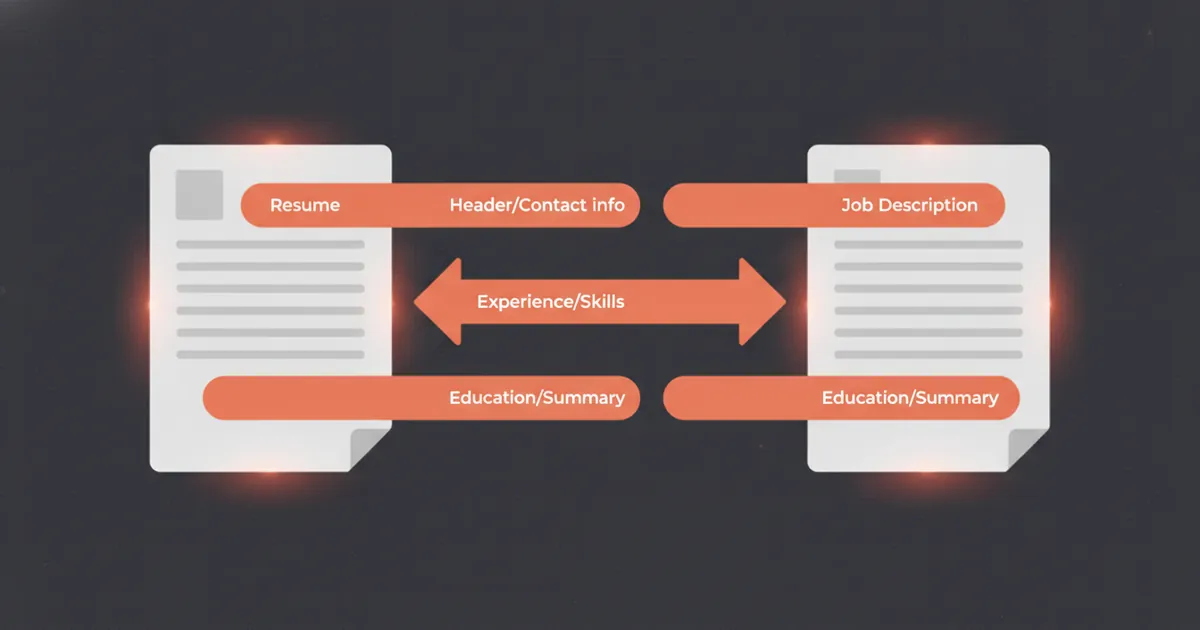
A static resume sent to 100 applications is lower-ROI than a tuned resume sent to 20. Scan the job description for the three to five most repeated outcome words (words like "pipeline," "retention," "deployment frequency," "cost reduction"). Surface your bullets that use those exact terms, ATS keyword scoring rewards exact-match phrases.
You don't need to rewrite the whole resume. Swap the top bullet on each role to mirror the language of the job you're targeting. That one change materially moves your ATS ranking and shows the hiring manager immediate relevance.
For role-specific templates and example bullet structures by job title, browse resume examples by role to see how the formula applies in context.
Putting It All Together: A Checklist Before You Submit
Before your resume goes out, run each work experience bullet through this filter:
- Does it start with a past-tense action verb?
- Does it include at least one number (percentage, dollar, volume, time, headcount)?
- Is it one to two lines, no longer?
- Is it specific enough that someone who doesn't know your company can understand the scale?
- Does it describe your contribution, not just what the team or company achieved?
If a bullet fails two or more of these, rewrite it before applying. Fifteen minutes of revision per role is the highest-ROI resume work you can do.
For structured interview prep once your resume lands callbacks, explore common interview questions by role, practice articulating the stories behind your bullets before you're in the room.
When you're ready to build a clean, ATS-optimized resume around these bullet points, try OfferFlow free: the resume builder formats your bullets correctly and lets you track every application in one place.