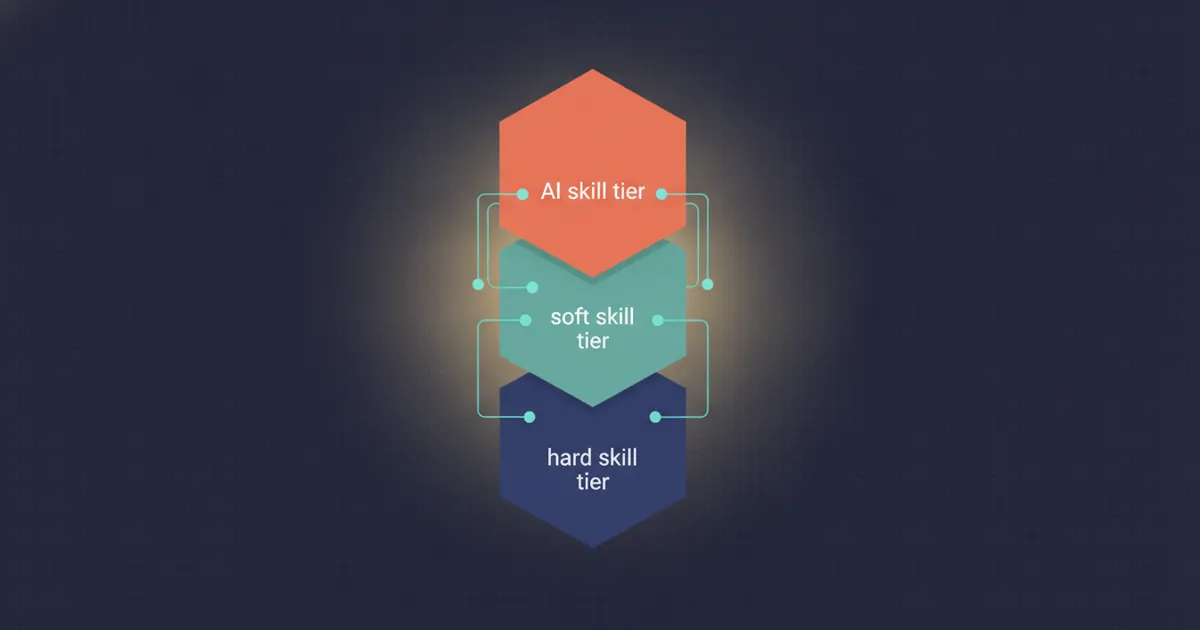
The skills to put on your resume matter more now than they did two years ago, and not just because hiring is competitive. According to LinkedIn's 2026 Skills on the Rise report, AI engineering, operational efficiency, and AI business strategy are the three fastest-growing skills in the US job market. Meanwhile, the World Economic Forum's Future of Jobs Report 2025 found that 39% of the core skills employers require will change by 2030. If your skills section is a copy-paste from 2022, it's working against you.
This guide breaks down the hard skills, soft skills, and AI-specific skills that are actually getting candidates hired in 2026, with specifics on which roles need them and how to list them so they clear ATS filters and catch a recruiter's eye.
Why Your Skills Section Has Become a Gating Mechanism
Most companies use applicant tracking systems that parse resume text before a human ever sees it. A 2026 analysis by HiroCV found that resumes missing keyword-matched skills from the job description fail ATS screens at a rate of over 70%. The skills section, along with your bullet points, is where those keywords live.
But it's not just ATS. Recruiters speed-reading a shortlisted resume spend roughly six seconds on a first scan. A well-structured skills section gives them an immediate signal that you fit the role. A bloated or outdated list (still listing "Microsoft Office" as a standalone skill, for example) signals the opposite.
The goal is a skills section that is accurate, specific, and role-relevant, not a comprehensive inventory of everything you've ever touched.
Hard Skills Employers Are Hiring For in 2026
Hard skills are teachable, testable competencies. They're the most ATS-critical part of your resume because they match directly against job description language. These are the categories showing the strongest demand signals right now.
Data and Analytics
Data analysis has been the most consistently listed technical requirement across job postings for three years running. In 2026 this spans far beyond traditional analyst roles. Operations managers, marketing leads, and product managers are all expected to work with data directly.
Skills to list (be specific):
- SQL: still the most universal data skill; used in analytics, backend, product, and ops roles
- Python: especially for roles involving any automation, analysis, or reporting
- Excel / Google Sheets (advanced), pivot tables, VLOOKUP/XLOOKUP, Power Query
- Tableau, Power BI, or Looker: name the tool you actually know; don't list all three if you only know one
- Data storytelling: translating numbers into decisions; increasingly called out in non-technical job descriptions
Cloud and Infrastructure
Cloud computing skills continue to outpace the supply of qualified candidates. Robert Half's 2026 Technology Salary Trends report places cloud architects and cloud security engineers among the highest-demand roles, with salaries ranging $140,000–$220,000.
Skills to list:
- AWS, GCP, or Azure: specify your platform and certification level if you have one
- Docker / Kubernetes: standard for any DevOps, platform, or backend engineering role
- Terraform or Infrastructure-as-Code: increasingly expected in senior engineering positions
- Cloud security basics: even non-security roles are starting to list this as a "nice to have"
Cybersecurity
Cybersecurity job postings have grown 62% year over year according to the WEF 2025 report, driven partly by AI-related threat expansion. These skills are relevant not just for security roles but for any IT, compliance, or engineering position.
Skills to list:
- Network security fundamentals
- Security Information and Event Management (SIEM) tools (Splunk, Microsoft Sentinel)
- Risk and compliance frameworks (SOC 2, ISO 27001, NIST)
- Identity and access management (IAM)
Project and Operations Management
The demand for structured execution skills has grown sharply as teams get leaner. Cross-functional coordination was one of LinkedIn's fastest-growing soft-skills-adjacent competencies in their 2026 data, but it's also backed by hard credentials.
Skills to list:
- PMP certification or Agile/Scrum certifications (name the credential, not just "project management")
- JIRA, Asana, Monday.com, or Linear: name the tools you've actually managed work in
- OKR / KPI frameworks: listed in an increasing number of operations and strategy job descriptions
- Lean / Six Sigma: relevant for manufacturing, logistics, healthcare, and ops-heavy roles
Soft Skills That Actually Belong on a Resume
Soft skills are genuinely in demand, the WEF report found that analytical thinking, creative thinking, and resilience are among the top core skills employers consider essential. The problem is that most people list them as bare words ("team player," "good communicator") that carry zero weight.
The fix: either embed soft skills into your bullet points with evidence, or list them only when they're specific enough to be meaningful.
Analytical Thinking
Analytical thinking has been the number-one core skill in the WEF's employer surveys for three consecutive reports. It's not a single skill. It's a cluster: breaking down ambiguous problems, identifying what data matters, and making defensible decisions under uncertainty.
On a resume, show it: "Analyzed 18 months of churn data to identify a 23% drop-off at the trial-to-paid conversion step; proposed and tested three interventions that reduced churn by 11%."
Stakeholder Communication and Executive Presentation
LinkedIn's 2026 data specifically named executive and stakeholder communication as a fast-growing demand area. This is distinct from generic "communication skills". It means structuring complex information for non-expert audiences, managing up, and driving decisions in meetings.
List it as: Stakeholder communication or Executive presentations: not just "communication."
Adaptability and Resilience
Named explicitly in the WEF and LinkedIn reports, this reflects the reality that most roles in 2026 are in organizations undergoing continuous restructuring around AI and automation. Employers want people who recalibrate quickly, not people who stall when the playbook changes.
On a resume, show it through context: "Managed three product pivots in 14 months while maintaining 90%+ sprint completion rate."
Cross-Functional Collaboration
With flatter org structures and more cross-department AI projects, the ability to work across functions, engineering, design, marketing, legal, is showing up in job descriptions that previously didn't mention it.
Leadership and Coaching
Even for individual contributor roles, many 2026 job descriptions include "mentorship" or "ability to influence without authority." This matters especially for senior ICs who want to move into management.
AI Skills: The Category That Changed Everything
This is where the biggest hiring shift is happening. Workers in AI-fluency-required occupations grew from 1 million in 2023 to 7 million in 2025, according to labor market data. AI skills now carry a 56% wage premium, more than double the 25% premium from just one year prior.
But "AI skills" has become a catch-all that means very different things depending on the role. Here's how to think about it in tiers.
Tier 1: AI Literacy (Every Professional)
Every knowledge worker in 2026 is expected to have baseline AI fluency. This means knowing how to use AI tools effectively in your daily work, understanding their limitations, and not needing hand-holding to get started.
Skills to list:
- AI-assisted workflows: using tools like ChatGPT, Claude, Copilot, or Gemini to accelerate real work tasks (writing, analysis, summarization, research)
- Prompt engineering: crafting effective prompts for consistent, high-quality outputs; listed in roughly 9% of all non-technical job postings as of 2026
- AI tool evaluation: knowing how to assess an AI output for accuracy and appropriate use
Roughly 9% of HR postings and 15% of marketing job postings now explicitly mention AI, according to Indeed data, and the actual expectation far exceeds what's written in JDs.
Tier 2: AI Application (Domain Specialists)
For analysts, marketers, product managers, operations leads, and anyone working with data or content at scale, more specific AI application skills are now expected.
Skills to list:
- AI-assisted data analysis: using AI to accelerate exploratory analysis, anomaly detection, or reporting
- Generative AI for content: knowing how to use AI for first drafts, editing, and SEO without producing low-quality output
- AI workflow automation: tools like Zapier AI, n8n, or custom GPT integrations that automate repetitive processes
- RAG (Retrieval-Augmented Generation) basics, understanding how AI queries company knowledge bases; increasingly listed in product and operations roles
- AI governance and ethics: knowing when not to use AI, how to audit outputs for bias, and compliance basics; listed in an increasing number of HR, legal, and compliance postings
Tier 3: Technical AI (Engineers and Data Scientists)
For technical roles, AI engineering is the highest-demand skillset in the market. LinkedIn named it the #1 fastest-growing skill globally in 2026.
Skills to list:
- Python with ML frameworks (PyTorch, TensorFlow, HuggingFace)
- LLM fine-tuning and model evaluation
- MLOps tools (MLflow, Weights & Biases, Kubeflow)
- Vector databases (Pinecone, Weaviate, pgvector)
- AI security and red-teaming
Robert Half's 2026 data shows AI engineers earning median salaries around $170,750, with senior specialists exceeding $250,000.
How to Format and Place Your Skills Section
The skills section is typically a short list near the top of the resume (after the summary) or in a sidebar column. A few practical rules:
Be specific, not categorical. "Data analysis" is weaker than "SQL, Python, Tableau." "Cloud computing" is weaker than "AWS (EC2, S3, Lambda), certified Solutions Architect."
Match the job description. If the posting says "Salesforce CRM," don't list "CRM software." Exact language matters for ATS. Run your skills against the job description before applying. A resume builder with ATS tools can flag gaps automatically.
Don't pad. Listing skills you can't demonstrate in an interview is a liability, not an asset. Recruiters test for skills during screens.
Organize by category. A clean structure: Technical Skills / AI & Automation / Tools & Platforms / Languages (if relevant). Avoid a wall of comma-separated words with no structure.
Put your strongest skills first within each category. Recruiters read left to right, top to bottom.
Tailoring Skills to Your Target Role
A single skills section rarely works for multiple job types. Here's a practical approach:
- Pull the top 10–15 skills from the job description you're targeting
- Cross-reference with your actual experience
- Add any matches you forgot to list, remove skills that aren't relevant to this role
- Adjust terminology to match the posting's language exactly
For roles like software engineer, it's worth checking interview question guides for software engineers to understand what technical skills get probed in depth. That should inform what you claim on your resume.
For roles with salary transparency, cross-checking salary data for your target role and city helps you understand which skills are commanding premium comp. Those are the ones worth investing time to develop and list prominently.
Skills That Are Losing Relevance (or Getting Commoditized)
Not every skill ages equally. These are declining in their signal value:
- "Microsoft Office" as a standalone skill, assumed at this point unless you're listing Excel at an advanced level
- Basic social media management: saturated; only relevant if paired with analytics or paid media skills
- Generic "communication skills": meaningless without context
- Entry-level coding languages listed without projects or applications. "I know Python" with no supporting evidence reads as noise
- SEO listed alone. Now needs to be paired with AI-assisted SEO or technical SEO specifics to be competitive
Certifications Worth Adding to Your Skills Section
Certifications signal commitment and provide third-party validation. In 2026, the ones most consistently cited in hiring data:
- Google Data Analytics Certificate or IBM Data Science Professional Certificate: strong for career changers moving into analytics
- AWS Certified Solutions Architect or Google Cloud Professional: industry standard for cloud roles
- PMP or PMI-ACP: recognized globally for project and program management
- Certified Information Systems Security Professional (CISSP) or CompTIA Security+: cybersecurity roles
- Salesforce Administrator or Developer: CRM-focused roles in sales, marketing, and ops
- LinkedIn Learning AI courses: lower barrier, but useful for Tier 1 AI literacy credentialing
List certifications either in the skills section (in parentheses after the skill) or in a dedicated Certifications section below Education.
The most competitive candidates in 2026 aren't generalists who claim everything or specialists with a one-dimensional skill set. They're what hiring data is starting to call "skill stackers": professionals who layer a technical core (data analysis, cloud tools, AI literacy) with strong human capabilities (analytical thinking, stakeholder communication, cross-functional execution). That combination shows up repeatedly in high-growth, high-paying role categories.
Before your next application, check your skills section against a real job description. If the language doesn't match, rewrite it. If the skills aren't there, decide whether they're worth acquiring. A cover letter that pairs well with a sharp skills section, see cover letter examples for how to connect skills to narrative, is a stronger package than either document alone.
Track which skill variations are getting you responses versus silence. If you're managing applications across multiple roles, a job tracker makes it much easier to see patterns in what's working.