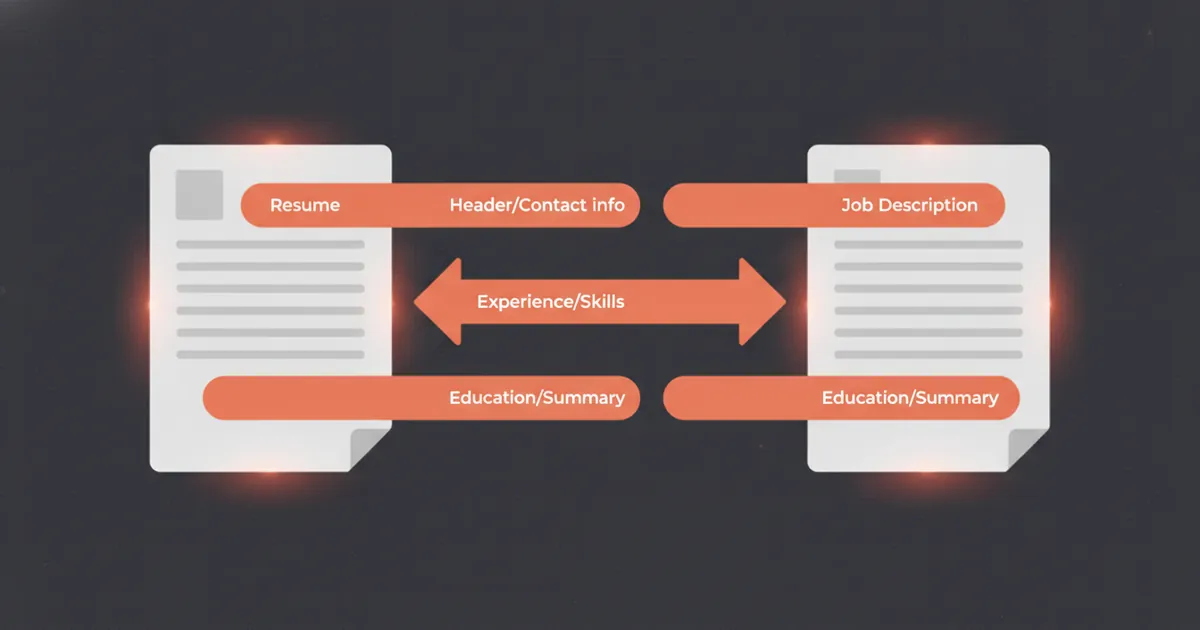
Choosing the best resume format in 2026 is not a cosmetic decision. It determines whether your application survives an automated screening system before a recruiter ever sees your name. With 97% of Fortune 500 companies running applicant tracking systems and the median ATS score sitting at just 48 out of 100 (meaning most resumes are already missing roughly half the keywords a job description expects), the structure of your document directly affects your chances of landing an interview. This guide breaks down when to use each format, how ATS software treats each one, and the exact scenarios where a hybrid approach outperforms both extremes.
The Three Resume Formats, Defined
Before getting into which one wins for your situation, a quick orientation:
Reverse-chronological lists your work history starting with your most recent role and works backward. It is the default expectation in virtually every US industry.
Functional (also called skills-based) leads with a grouped skills section and either omits dates entirely or buries them at the bottom. Its stated goal is to spotlight capabilities rather than a timeline.
Hybrid (combination) opens with a professional summary and a targeted skills block, then transitions into a full reverse-chronological work history. It tries to get the best of both without the liability of a pure functional format.
Why Reverse-Chronological Still Dominates
Reverse-chronological is not the default because recruiters are lazy. It is the default because it is the most information-efficient format for the people reading it. A recruiter scanning 200 applications in a morning wants to know: where did you work, what was your title, how recently, and for how long. Chronological order answers all four questions in under ten seconds.
From an ATS perspective, the advantage is decisive. Single-column reverse-chronological layouts achieve roughly 93% parsing accuracy compared to about 86% for two-column designs, and the gap widens when you introduce non-standard section headers or remove date ranges. Many ATS platforms in 2026, Workday, Greenhouse, iCIMS, are tuned to expect a dated work history. When that structure is absent, the parser either misfiles your experience or flags the document for manual review rather than surfacing it as a strong match.
Use reverse-chronological if:
- You have a consistent work history with no gaps longer than about six months
- You are staying in the same field or moving to a closely adjacent role
- You are applying to mid-size to large employers who almost certainly use an ATS
- You are an early-career candidate with 1–3 jobs whose timeline tells a clear progression story
The one thing reverse-chronological cannot hide is a gap or a pivot. If either applies to you, read the hybrid section below before settling on this format.
The Problem With Functional Resumes in 2026
The functional resume was designed to help candidates with gaps, career changes, or unconventional backgrounds by leading with skills instead of a timeline. The logic made sense in a pre-ATS world. It no longer does.
Modern ATS software specifically looks for chronologically ordered work entries tied to dates. When those are absent or deprioritized, the system either scores the document poorly or fails to extract experience data at all, image-based PDFs (common when people try to design around the limitation) have an 85% parsing failure rate. Plain DOCX files sit at just 4%. The format choice matters.
Beyond the ATS problem, recruiters in 2026 are trained to treat a functional resume as a signal that something is being hidden. A 2025 survey of 25 US recruiters across more than ten ATS platforms found that 92% said their system does not auto-reject based on content, but the same recruiters said they personally scrutinize functional formats more heavily because the lack of a timeline reads as evasive. You are optimizing for a human reaction that works against you.
When functional resumes were supposed to help and what to do instead:
- Employment gaps → use hybrid with honest date labeling (see below)
- Career change → use hybrid with a strong professional summary bridge
- Overqualification concern → use reverse-chronological and tailor your bullet points to the level of the target role
- Short tenure or job-hopping → use reverse-chronological with context in bullet points, not by hiding dates
There is almost no scenario in 2026 where a functional resume is your best option.
The Hybrid Format: When It Earns Its Keep
The hybrid or combination format takes reverse-chronological work history as its backbone but adds two structural elements at the top: a tailored professional summary (3–4 sentences) and a concise skills block. Done right, it parses within 2–3 percentage points of a pure chronological layout in every major ATS engine, Workday scores around 94% versus 96% for chronological, Greenhouse around 92% versus 95%, iCIMS around 89% versus 92%. The tradeoff is marginal; the strategic benefit can be significant.
The hybrid earns its place in four specific situations.
Career Changers
If you are moving from, say, operations management into product management, a reverse-chronological format puts "Operations Manager" at the top of your experience section. The exact job you are trying to move away from. A hybrid format lets you open with a summary that explicitly frames your transferable skills (process ownership, stakeholder communication, data-informed decision-making) before the recruiter reaches your title history. You are not hiding your background; you are contextualizing it before the reader forms an impression they will struggle to revise.
Candidates With a Significant Employment Gap
A gap of 12 months or more is visible no matter what format you use. The hybrid approach helps you control the narrative by leading with what you accomplished before and what you bring now, rather than opening with a blank period. For gaps, label them directly, "Career Break: Caregiving" or "Independent Consulting", and include year ranges. Attempting to obscure gaps with year-only dating (2022–2024 instead of March 2022–November 2024) works for gaps under six months; for longer ones, it reads as a manipulation tactic to anyone who has reviewed resumes for more than a week.
Mid-Career Professionals With Broad Skill Sets
Ten or fifteen years of experience often means your most transferable skills are scattered across several roles. A hybrid's skills block lets you surface the four or five competencies most relevant to the specific job posting without forcing a recruiter to piece them together from five separate bullet point sections. It is not about burying your history. It is about creating a navigational shortcut.
Returning Veterans and Non-Traditional Candidates
Military-to-civilian transitions, re-entry after caregiving, return from graduate school, or any background where your most recent role does not map cleanly onto the job posting all benefit from the hybrid's ability to open with capability framing rather than title history.
How to Choose: A Decision Framework
Run through these questions in order:
- Does your work history tell a clear, uninterrupted story in the right direction? If yes, reverse-chronological. Stop here.
- Are you changing industries or roles significantly? If yes, hybrid.
- Do you have a gap longer than six months in the last five years? If yes, hybrid.
- Are you applying to companies that almost certainly use an ATS (any company with 50+ employees)? If yes, do not use functional regardless of what other factors suggest.
- Are you a freelancer, consultant, or portfolio-career professional where chronological order creates an artificially choppy-looking history? Hybrid, with a clear summary that frames the portfolio nature of your career.
Formatting Rules That Apply to Every Format
Regardless of whether you go chronological or hybrid, these structural decisions affect both ATS parsing and recruiter readability.
File Type
Submit as PDF unless the job posting explicitly requests a Word document. PDF preserves your formatting across devices. DOCX has a 4% parsing failure rate compared to PDF's 18%, but modern ATS systems handle PDF well when the document is text-based (not scanned). If you built your resume in a design tool like Canva and are exporting it as an image-heavy PDF, switch to a text-based tool. The image-based version is effectively invisible to parsers.
Column Layout
Single-column layouts parse at 93% accuracy; two-column layouts drop to 86%. If you are applying through an ATS (which you almost certainly are), a single-column layout is the safer choice. Visual appeal matters less than data integrity when a machine is reading your document first.
Fonts and Spacing
Use a serif or professional sans-serif font at 10–12pt for body text. Calibri, Georgia, Garamond, and Arial are all safe. Avoid decorative typefaces, icon-based skill ratings (ATS cannot read a five-star graphic), and tables or text boxes (many parsers skip content inside them entirely).
Section Headers
Stick to standard labels: Work Experience, Education, Skills, Certifications. Clever alternatives like "Where I've Made an Impact" or "My Toolkit" may feel distinctive but cause parsers to misfile the section.
Length
A 2026 survey found that 68.6% of recruiters now prefer two-page resumes, with only 21.6% holding to the one-page rule. The practical guidance: one page for under five years of experience, two pages for five or more. Never go beyond two pages unless you are a senior executive with a legitimate publication or patent record that requires documentation. One hundred percent of recruiters say they would stop reading a resume longer than four pages.
Tailoring
Sixty-three percent of hiring managers prefer resumes tailored to the specific job. This means mirroring language from the job description in your skills section and bullet points, not keyword stuffing, but using the same terminology the employer uses. If the job posting says "cross-functional collaboration" and your resume says "worked with different teams," the ATS may not match them. Use OfferFlow's resume builder to track tailored versions of your resume alongside the job applications they belong to, so you always know which version went where.
Writing Bullet Points That Work Inside Any Format
Format determines structure; bullet points determine whether you get the call. A few rules that hold regardless of which format you choose:
- Lead with a strong action verb: managed, built, reduced, launched, negotiated: not "responsible for" or "helped with"
- Quantify wherever possible: percentages, dollar figures, headcount, time saved, conversion rates
- Tie results to scope: "reduced onboarding time by 30% across a team of 45 new hires" beats "improved onboarding"
- Keep bullets to 1–2 lines; if a bullet needs three lines, it is two bullets trying to share a sentence
If you are a software engineer, see OfferFlow's software engineer resume examples for format and bullet benchmarks by seniority level. For roles with an active interview process, interview question guides by role can help you make sure your resume claims hold up under questioning.
ATS-Specific Mistakes That Sink Good Resumes
Even a well-formatted reverse-chronological resume can score poorly if you trip any of these:
- Headers and footers: Many parsers skip content in the document header/footer region. Put your contact information in the body of the document, not in a designed header block.
- Acronyms without expansion: Write out acronyms at least once. "Search Engine Optimization (SEO)" covers both the spelled-out version a human might search and the acronym the JD uses.
- Inconsistent date formats: Mix of "Jan 2022" and "2022–2024" in the same document causes parsing errors. Pick a format and apply it throughout.
- Missing location data: Some ATS filters screen by location. Include a city and state even if you are open to remote work.
- Embedding keywords only in the skills section: Distribute target keywords through your experience bullet points as well. A keyword that appears only in a laundry-list skills section carries less semantic weight in most modern parsers.
Salary and Market Context
Your resume format does not exist in isolation from market positioning. Once you have the right structure, make sure your experience and title framing aligns with what the market pays for your role. OfferFlow's salary guides by role and city can help you benchmark your positioning before you start applying, so your resume targets the right tier of role from the start.
The Bottom Line
For most candidates in 2026, reverse-chronological is still the right call. It is what ATS systems expect and what recruiters find fastest to evaluate. Hybrid earns its place for career changers, candidates with gaps, and mid-career professionals whose skills span multiple roles. Functional resumes solve a problem that no longer exists and create problems that do. Whatever format you choose, a single-column PDF with standard section headers, tailored keywords, and quantified bullet points will outperform a visually complex document on the platforms where most hiring actually happens.
If you want to stop managing resume versions in a folder of untitled Word documents, OfferFlow keeps your tailored resumes, job applications, and interview prep in one place, so the formatting work you put in here actually translates into a organized, trackable job search.