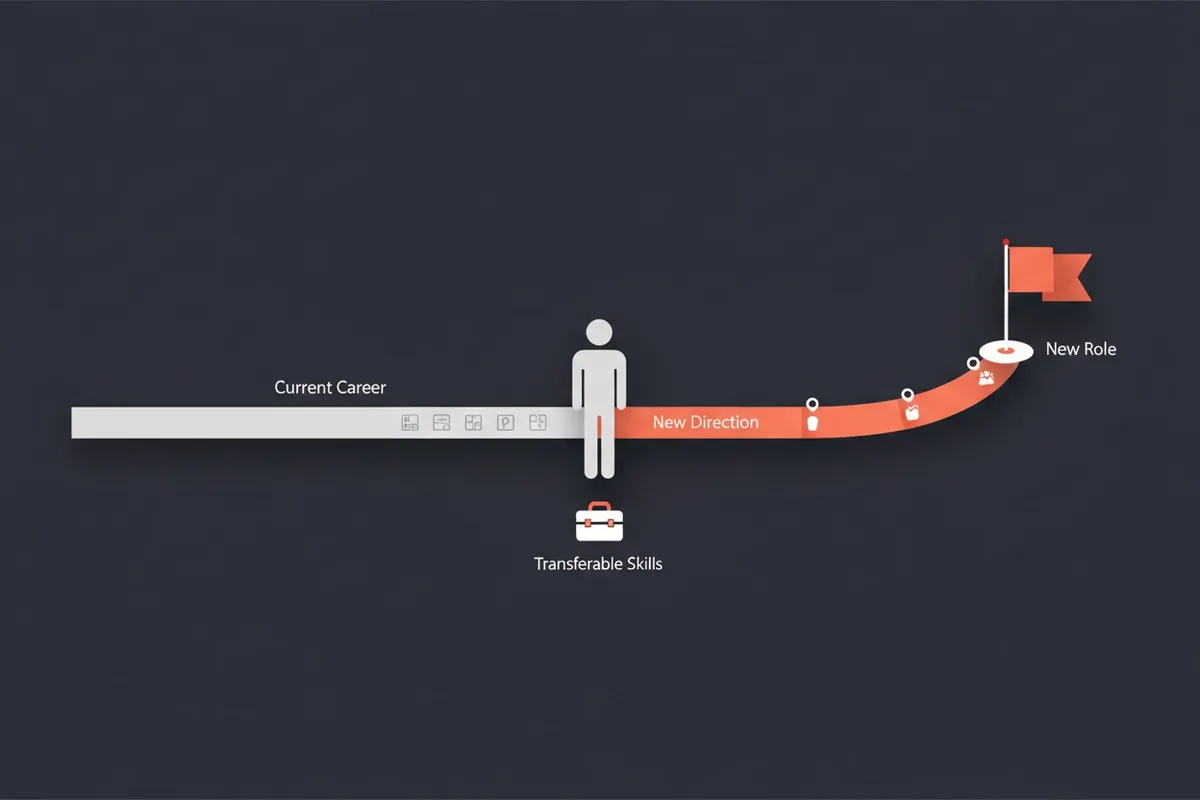
Your career change resume has one job: convince a hiring manager in a new field that your background is an asset, not a liability. Most career changers fail at this because they submit a resume optimized for the job they're leaving, not the one they want. This guide shows you exactly how to reframe your experience, structure the document, and pass ATS filters so your career change resume actually lands interviews.
Why Career Change Resumes Fail (And What the Data Says)
The average American worker holds around 12 jobs over a lifetime, according to the Bureau of Labor Statistics, and inter-industry moves are common at every experience level. Yet the resume most people submit when switching fields is just their old resume with a new cover letter slapped on top. That approach fails for three reasons.
First, job titles from your previous industry carry no weight with a hiring manager who doesn't know how your old role maps to theirs. "Senior Relationship Manager" at a bank means something specific in financial services; in healthcare it reads as vague. Second, the terminology you've spent years using, the jargon that signals expertise in your old field, is noise in a new one. ATS systems scan for keywords from the job description, and 75% of resumes are rejected by applicant tracking software before a human ever sees them, according to Resume Genius's HR statistics research. Third, a standard reverse-chronological layout puts your most recent, least-relevant work front and center.
The fix isn't a wholesale reinvention. It's a deliberate reframe of what you already have.
Choose the Right Resume Format
The format debate for career changers usually comes down to three options: reverse-chronological, functional, or hybrid. Here's the practical breakdown.
Reverse-chronological lists your most recent job first. Familiar to hiring managers and friendly to ATS. The problem: if your most recent jobs are in a different industry, you're leading with the wrong story.
Functional groups everything by skill category and buries the dates. On paper this seems like a career changer's dream. It hides the irrelevant history. In practice, ATS systems frequently misparse functional resumes, and experienced recruiters distrust them. A functional format is a yellow flag that you're hiding something.
Hybrid (combination) is the right choice for most career changers. It opens with a strong skills and summary section that speaks directly to the new role, then follows with a standard reverse-chronological work history. You get the ATS compatibility of a chronological format and the strategic framing of a skills-first approach.
The hybrid structure gives you control over the first third of the resume. The part that determines whether the recruiter keeps reading.
Build a Targeted Professional Summary
The professional summary (2–4 sentences at the top) is where you make your career change explicit and position it as a strength. Don't try to hide the pivot. Address it directly, then immediately pivot to what you bring.
A weak summary for someone moving from teaching to instructional design:
"Experienced educator with 8 years in K-12 classrooms seeking new opportunities in corporate training."
That summary is passive and explains nothing about value delivered. A stronger version:
"Curriculum developer and facilitator with 8 years designing and delivering learning experiences for 30+ students per cohort. Built assessment frameworks that improved standardized test performance by 14% over two years. Bringing that same structured approach to adult learning and onboarding design in a corporate L&D environment."
The difference: specific outcomes, translated terminology, and a clear statement of what you're bringing, not what you're lacking.
Your summary should contain your primary target role title (or a near equivalent) and 2–3 skills that appear in the job descriptions you're targeting. This isn't keyword stuffing; it's alignment.
Map Your Transferable Skills Precisely
Sixty-three percent of employers say they're willing to hire and train candidates who have the right transferable skills, according to LinkedIn research cited by The Interview Guys, but you have to do the translation work for them. Hiring managers won't assume your skills transfer. You have to show the connection explicitly.
Start with a simple exercise. Pull 5–10 job descriptions for the roles you want. Highlight every skill, tool, and responsibility that appears more than once. Then go through your work history and find every place you actually did that thing, even if the job title or industry was different.
Common high-value transferable skills that move across industries:
- Project management: planning, scope definition, stakeholder communication, deadline management
- Data analysis: working with numbers, identifying trends, building reports, making data-driven recommendations
- Client or customer management: understanding needs, managing expectations, building relationships
- Team leadership: coaching, performance management, cross-functional coordination
- Writing and communication: reports, presentations, proposals, documentation
The key is specificity. "Strong communication skills" is ignored. "Wrote weekly executive briefings for a 12-person leadership team summarizing operational KPIs" is concrete and credible.
Rewrite Your Work Experience Bullets
Your work experience section stays in the resume, erasing it creates the same suspicion as a functional format. What changes is how you write each bullet.
The standard formula is: [action verb] + [what you did] + [measurable result]. For career changers, add a fourth element: [connection to new field] when it isn't obvious.
Before (teacher moving to project management):
"Taught 7th-grade math to 28 students."
After:
"Managed end-to-end delivery of a semester-long curriculum project for 28 students, scoped objectives, coordinated with 3 subject-matter colleagues, tracked progress against weekly milestones, and adapted scope mid-project when standardized test dates shifted."
The content is the same. The framing speaks directly to a project manager job description. Nothing fabricated, just translated.
Every bullet doesn't need this treatment. Focus on the 2–3 most relevant roles and 3–4 bullets each. Older or less-relevant roles can stay brief.
For roles where you want to show new-field skills you've been building outside of work, certifications, freelance projects, volunteering, create a brief "Relevant Projects" or "Additional Experience" section and put it above your older work history. This keeps the document honest while surfacing what matters most.
Handle the ATS Problem
Applicant tracking systems score your resume against the job description. For career changers, the core ATS challenge is vocabulary mismatch: you know the concepts, but you've been using different words for them.
Practical steps to close the gap:
Mirror the exact language from the job posting. If the JD says "cross-functional collaboration," use that phrase. Don't substitute "interdepartmental coordination" even if it means the same thing to you. ATS systems do exact and near-exact matching; a human can infer synonyms, an algorithm often can't.
Include a "Core Competencies" or "Skills" section. A simple 2-column grid of 8–12 skills lets ATS find your keywords fast. Keep it factual, only list skills you can discuss in an interview.
Use the standard job title as a keyword. If you're targeting "UX Designer" roles and your previous title was "Graphic Designer," you can list your actual title in your work history while making sure the phrase "UX design" appears in your summary and skills section.
Avoid tables, headers/footers, graphics, and text boxes. Most ATS systems can't parse these correctly. Use a clean single-column or simple two-column layout with standard section headers: Summary, Skills, Experience, Education, Certifications.
If you want to see exactly how your resume scores against a specific job description before you apply, OfferFlow's resume review tool runs an ATS match analysis and flags gaps in your keyword coverage.
Address Your Education and Certifications Strategically
Credentials can either reassure a skeptical hiring manager or confirm their doubts about your readiness. A few principles:
New certifications belong near the top. If you earned a PMP, a Google Data Analytics certificate, or a SHRM-CP for your target field, put it in a "Certifications" section right after your summary, or even include it in the summary line. This signals intentionality. You didn't just wander into this field; you prepared.
Older degrees are fine in a standard Education section. The field of your degree matters less than you think for most mid-career pivots. A history degree doesn't disqualify you from a sales operations role. Don't apologize for it; just don't lead with it if it's not relevant.
Bootcamps, online courses, and professional development count. A 6-month UX bootcamp from a recognized provider, a LinkedIn Learning path completed this year, a completed capstone project. These all belong in the resume. Be specific about what you built or completed, not just that you attended.
Don't list certifications you haven't earned yet. "Currently pursuing AWS Solutions Architect certification" in a skills section is a red flag. If it's in progress, put it in your education section with an expected completion date.
Structure the Full Document
Here's a clean order for a career change resume:
- Contact information: name, city/state, phone, professional email, LinkedIn URL, portfolio or GitHub if relevant
- Professional summary: 2–4 sentences, targeting the new role
- Core competencies / Skills: 8–12 skills in a compact grid
- Certifications (if directly relevant to the new field), list with issuer and year
- Relevant Projects or Freelance Experience (if applicable), 2–4 entries with bullets
- Work Experience: reverse-chronological, reframed bullets
- Education
- Additional Certifications / Professional Development (if not listed earlier)
Keep the document to one page if you have under 10 years of experience, two pages if you have more. Remove anything that doesn't serve the new role's narrative. A 15-year-old job at a different company in a different field doesn't need three bullets.
Pair the Resume With the Right Cover Letter and LinkedIn Profile
A career change resume works harder when it's supported by the other parts of your application.
Your cover letter is where you can address the pivot directly in plain language. One paragraph explaining what drove the decision, concisely, professionally, without over-explaining, pre-empts the recruiter's main concern. Focus the rest of the letter on what you bring, not on what you lack.
Your LinkedIn profile should reflect the same positioning as your resume. Your headline shouldn't say your old title if you're actively pivoting; update it to reflect where you're going. Use the "About" section to tell the transition story in your own voice.
For role-specific preparation, OfferFlow's interview question guides include common career-change interview questions by role, worth reviewing before you apply so the "why are you switching?" question doesn't catch you off guard.
Common Mistakes to Avoid
Using a functional resume format. As covered above, it raises red flags and often fails ATS. Hybrid is better.
Listing responsibilities instead of achievements. "Responsible for customer service" says nothing. "Resolved 40+ escalated customer issues per week with a 94% satisfaction rating" says something useful.
Leaving the transition unexplained. If your resume shows 10 years in accounting and suddenly you're applying for marketing roles with no indication of why, hiring managers assume confusion or desperation. A clear summary that frames the pivot removes that assumption.
Applying to roles you're genuinely underqualified for. A career change resume can bridge a skills gap; it can't manufacture years of hands-on domain experience. Target roles one level below where you'd be if you were an industry insider. You can move up faster once you're in.
Not customizing for each role. A single career change resume sent to 50 jobs will underperform a targeted resume sent to 15. The ATS keyword matching alone justifies customizing the skills section and summary for each posting.
The Hiring Manager's Perspective
Career change hires are a calculated bet. The hiring manager knows you don't have the exact background they'd prefer. They're choosing you anyway because they believe your skills transfer and you'll grow into the role faster than your resume suggests.
Your job is to make that bet feel safe. That means a resume that's organized and easy to skim, specific achievements that demonstrate competence, and framing that shows you understand what the new role actually requires, not just that you're enthusiastic about it.
The World Economic Forum's Future of Jobs Report 2025 projects that 39% of existing job skills will be disrupted by 2030. Companies that hire only for direct experience are already falling behind. Skills-based hiring is accelerating, and a well-constructed career change resume positions you precisely for that shift.
For roles where salary benchmarking matters, especially if you're moving to a field with a different pay structure. OfferFlow's salary data by role and location can help you understand what to expect before you negotiate.
A career change resume that works isn't a desperate document. It's a strategic one that respects the reader's time, speaks their language, and makes a clear case for why your unusual path is exactly what they need.