The standard career-change advice is built for twenty-somethings. "Get a new degree, start at entry-level, work your way up." That works if you're 24 and unattached. It's brutal if you're 35 with a mortgage and a kid, or 45 with a senior role you've spent two decades building.
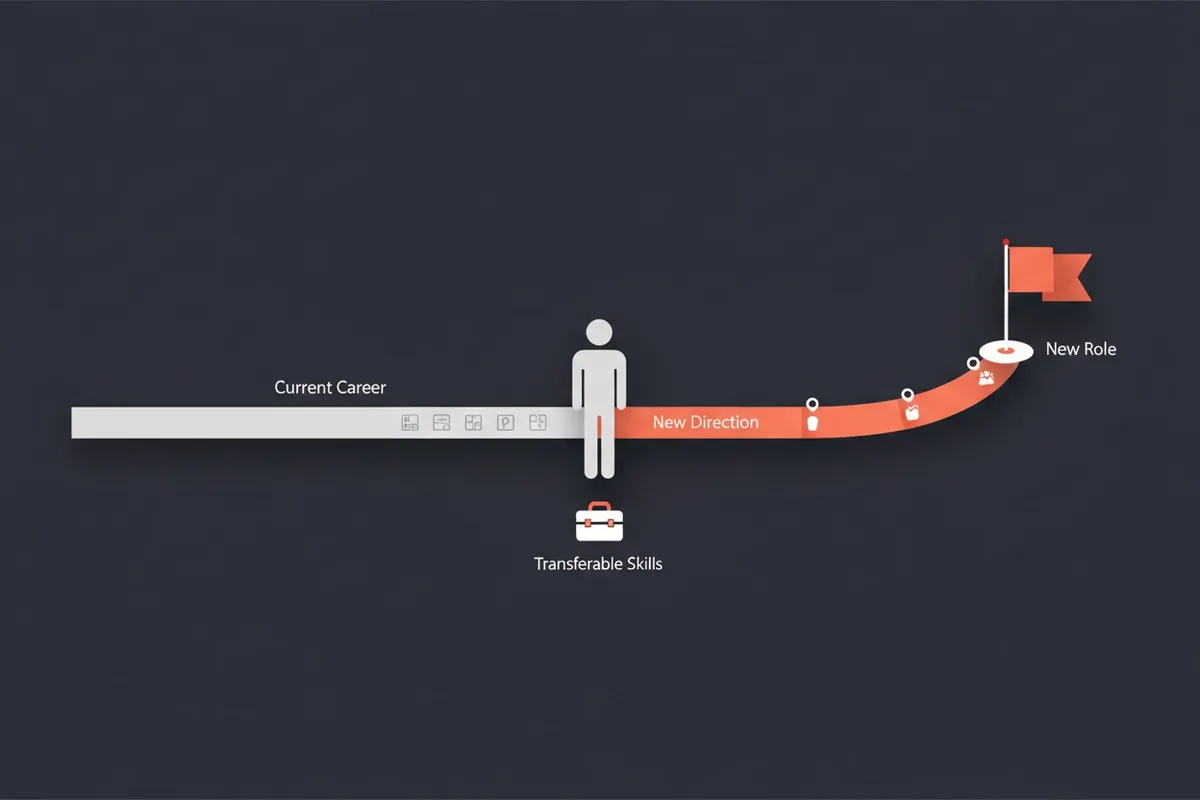
The truth is that most successful mid-career pivots aren't restarts. They're rotations. You carry forward most of your earnings and seniority, you reposition specific skills for a new context, and you bridge with one or two strategic moves. The candidates who pivot well finish with the same salary or higher within 12 months. The candidates who try to "start over" take 3+ years to recover.
This guide is the framework for the rotation, not the restart. It covers three types of pivots, a transferable skills audit that finds your bridges, and the realistic salary expectations for each path.
3 Types of Career Pivots
Not all pivots are the same. Pick your category honestly:
Adjacent pivot. Same function, different industry. A B2B SaaS marketer becoming a B2B fintech marketer. A data analyst moving from healthcare to retail. The function is identical; the domain changes.
This is the easiest pivot. Timeline: 3–6 months. Salary impact: usually flat or +5%.
Skill pivot. New function, same industry. An engineer becoming a product manager at the same company size and industry. A marketer becoming a customer success leader in the same vertical.
Medium difficulty. Timeline: 6–12 months. Salary impact: typically -5% to -15%, recovered in 18 months.
Full pivot. New function AND new industry. The "complete reinvention" most career-change books focus on. A teacher becoming a UX designer. A lawyer becoming a product manager.
Hardest. Timeline: 12–24 months. Salary impact: often -20% to -40%, sometimes longer to recover.
Most career-change advice assumes everyone needs a full pivot. They don't. Most people pivot adjacent or skill, and the framework below works for all three.
Step 1: Transferable Skills Audit
Before you decide where you're pivoting to, audit what you carry forward.
List every skill from your current role on paper. Include the obvious (technical skills, certifications) and the less-obvious (project management, stakeholder communication, presenting to executives, hiring, conflict resolution, business intelligence). Don't filter yet, just brain dump.
Then sort each into two buckets:
Function-specific skills. These don't transfer. A SQL query optimization expert moving into UX design doesn't get to count this skill.
Cross-functional skills. These transfer to almost anything. These are your bridges. Examples:
- Project management
- Stakeholder communication
- Data analysis (the discipline, not the specific tool)
- Hiring and managing people
- Public speaking and executive presentations
- Budget management
- Vendor negotiation
- Crisis response
Most mid-senior professionals have 5–10 cross-functional skills they take for granted because they've been using them daily for years. These are gold. They make you significantly more valuable than entry-level candidates in your target field, even if the function is new.
Step 2: Pick the Closest Adjacent
Successful pivots happen in proportion to how much you carry over.
A "B2B SaaS Senior Product Manager" pivoting to "B2B SaaS Senior Product Marketing Manager" is a 6-month transition. Most of the skills, vocabulary, and industry context carries forward. You're learning marketing-specific tactics on top of an existing PM foundation.
The same PM trying to become "Elementary School Teacher" is a 2-year transition with a 60% pay cut. Almost nothing carries.
Brainstorm three pivot targets, ranked by adjacency:
- Closest: same function, slightly different angle (often invisible from outside but high earning ceiling)
- Medium: new function, same industry where your domain knowledge buys you the seat
- Stretch: what you'd do if money didn't matter
Most people target the stretch and underestimate the closest. The closest is often the right move. It pays the bills, it leverages your existing network, and it sets you up for a SECOND pivot later if you really want the stretch.
Step 3: Rewrite Your Resume for the New Target
Resume strategy for pivots is different from a within-function search. You lead with transferable wins, not chronology.
Three changes from a standard resume:
Replace the summary with a positioning statement. Two sentences that explicitly frame the pivot:
"Senior Product Manager with 8 years scaling B2B SaaS products from $1M to $50M ARR. Pivoting to Product Marketing leadership, where my deep customer empathy and analytical rigor translate directly to GTM strategy."
You're naming the pivot. You're explaining why it makes sense.
Reorganize bullets by relevance, not chronology. Within each role, lead with bullets that demonstrate the new target skills. Push function-specific bullets to the end or cut them.
Match the new industry's vocabulary. Every domain has its own dialect. Read 10 job postings in your target field and note the exact phrasing. That's how you should describe your work, even if you used different words in your old field.
For the full tailoring framework, see how to tailor your resume for each job.
Step 4: Bridge Projects (Faster Than Bootcamps)
The fastest credential-building move isn't a bootcamp. It's one or two real projects in your target domain.
Three formats that work:
- Side projects. Build something, ship it, document the process. A would-be UX designer redesigns the worst part of a popular app and writes up the case study. Takes 4–8 weeks. Worth more than any bootcamp certificate.
- Volunteer work in your target function. Non-profits will let you do real work in fields you have no formal credentials in. A would-be data analyst running quarterly analysis for a local non-profit has a real portfolio piece in 6 weeks.
- Internal pivots. Often easiest of all: ask your current company for a stretch assignment in the target function. Many mid-senior pivots start as "I helped marketing for one quarter" before becoming a formal role change.
The internal pivot is underrated. Companies hate to lose senior talent and often create pivot paths internally if you ask directly. Worst case they say no, but you've at least signaled where you want to go, which often results in a different opportunity surfacing.
Step 5: Build a Pivot Network
This is the highest-leverage activity in any pivot. Most pivot hires come from warm referrals, not cold applications. Why?
When you're applying cold to a role you don't have an obvious resume match for, your application loses to ten candidates who do match. When you come in via warm referral, the hiring manager already has a reason to take a second look.
The goal: five real coffee chats (or async equivalents) with people in your target role over the next month. Not "informational interviews" with random LinkedIn contacts. Specific people in specific companies you'd actually want to work at.
How to get them:
- Start with your existing network. Anyone you know who's already done a similar pivot is gold. Reach out.
- Use mutual connections. Look up target companies on LinkedIn and find 2nd-degree connections.
- Use warm intros via people who'd vouch for you. See how to reach out to recruiters on LinkedIn for the structure that works.
The Salary Reality Check
Be honest with yourself about the financial impact:
- Adjacent pivot: usually flat, sometimes a small (+5%) bump because new company wants to win you over
- Skill pivot: typically a 5–15% cut, recovered within 18 months as you build the new function's market value
- Full pivot: 20–40% cut common, sometimes 50%+ at very specialized fields. Recovery can take 2–4 years.
If a 30% pay cut is a dealbreaker, narrow your target to adjacent pivots only. Don't lie to yourself about the financial math and end up taking the cut anyway in 9 months because you ran out of patience.
When to Get a Credential (Hint: Rarely)
Mid-career credentialing is overrated for most pivots. Skip the bootcamp, the second degree, the MBA, unless one of these applies:
- Your target industry is credential-gated. Healthcare administration, financial advisor, lawyer. You literally cannot work without the credential. Get it.
- The credential opens a specific door you can verify. "Companies X, Y, Z require AWS Solutions Architect cert for this role", fine, get it.
- You're using the credential as a forcing function for learning. You learn better with a structured program. Reasonable.
What doesn't work: "I'll get an MBA so people take my pivot seriously." Two-year programs cost $200K+ and produce far less pivot lift than two years of working in the target field while building bridge projects.
For most mid-career pivots, the right path is: bridge project + warm network + portfolio of work, not new credential.
Handling the "Why the Switch?" Interview Question
You'll get this question in every interview. Prepare a 90-second arc:
"I spent the last 8 years building [current function] expertise. Two things have pulled me toward [new function]: [specific reason 1] and [specific reason 2]. The skills that translate most directly are [specific 2–3 transferable skills], and my recent [bridge project / volunteer work / internal stretch] confirmed this is where I want to keep going."
What makes this work: it's forward-looking, specific, and proves you've already done some work to validate the pivot. It's not "I'm bored" or "I want a fresh start."
Avoid:
- Bashing your current industry
- Vague "I just want a change"
- "I read a book and it inspired me"
- Framing the pivot as crisis-driven (especially if it actually was, keep that private)
For the full interview prep framework, see how to prepare for a job interview. The pivot-specific question is just one element of a broader interview strategy.
When the Pivot Starts From a Layoff
A common path: laid off, decide to use the disruption to pivot rather than return to the same field. This works, but it adds urgency that can hurt the pivot quality.
Two protective moves:
- Build a financial runway plan first. A pivot from a layoff with 3 months of savings forces you toward closest-adjacent and away from any pay cut. A pivot with 9 months of runway allows skill pivot. Match ambition to runway.
- Take a same-function bridge role if needed. Better to take a 3–6 month same-function role to refill the runway, then pivot from employment than to take a half-pivot under financial pressure.
For the broader layoff playbook, see what to do after getting laid off.
Tracking the Pivot
A mid-career pivot involves more parallel paths than a within-function search: bridge projects in flight, coffee chats with target-field contacts, multiple resume versions, separate applications for adjacent vs skill-pivot roles. Spreadsheets fall over fast.
OfferFlow supports custom swimlanes on the kanban. You can track adjacent-pivot applications, skill-pivot applications, and current-function "bridge" applications as separate parallel pipelines. That separation matters because the conversion rates are different, and you want to see each one clearly.
The Realistic Timeline
A 12–18 month timeline is normal for a real pivot. The internet is full of "I changed careers in 3 months" stories. They're either lying, or they did an adjacent pivot they didn't recognize as such.
Build the bridge project, run the network conversations, apply selectively, expect 6 months of soft progress before the breakthrough role. The candidates who push through this middle period are the ones who finish where they wanted. The candidates who panic at month 4 and accept a bad-fit role end up back in the original function within a year.
Mid-career pivots reward patience and structure. Build the system, work it consistently, and the new career is on the other side.