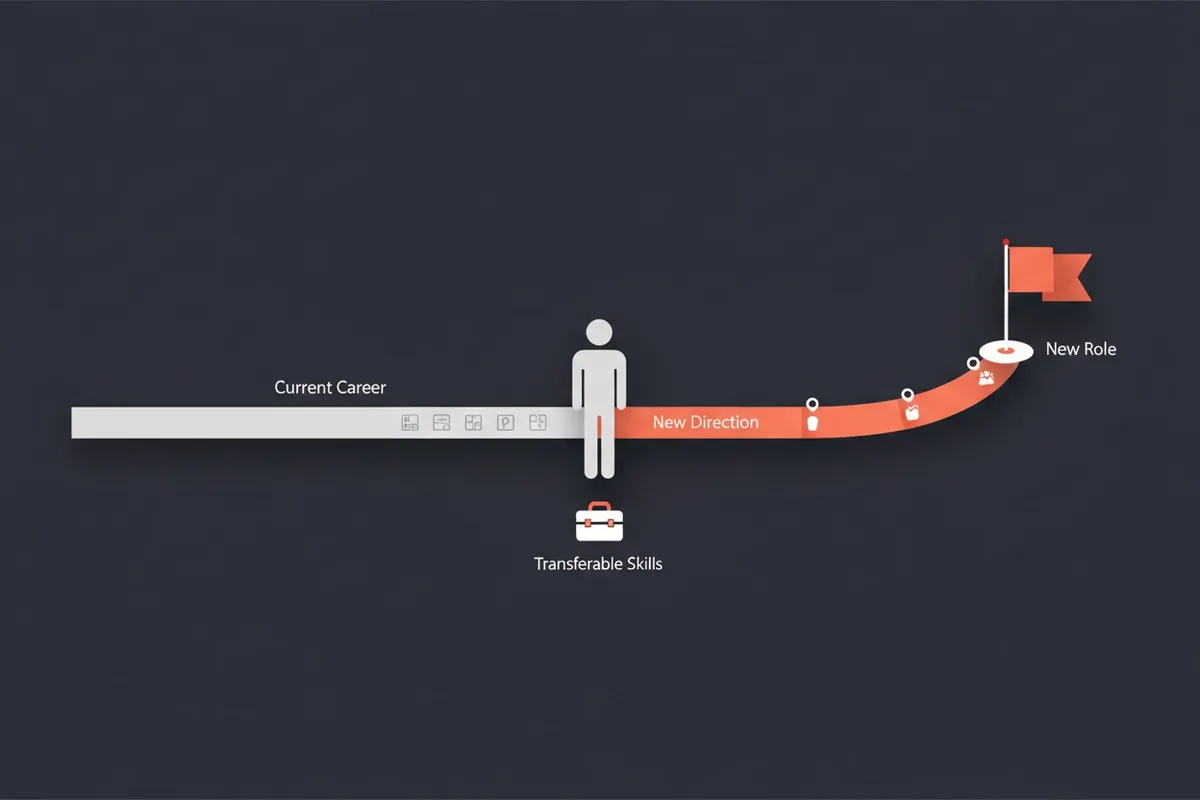
Writing a career change cover letter is one of the harder writing tasks in job searching, not because the format is complicated, but because you have to tell a coherent story backward. You're asking a hiring manager to look at ten years in one industry and see someone who belongs in another. Done right, that story is compelling. Done wrong, it reads like an apology. This guide walks through the mechanics of writing a career change cover letter that reframes your past without dismissing it.
Why Career Changers Face a Structural Problem in Cover Letters
Most cover letter advice assumes you're moving linearly. Same field, bigger title. Career changers don't have that luxury. You're working against a simple cognitive bias: hiring managers pattern-match against the last person who succeeded in this role, and your resume doesn't look like that person's.
The numbers tell you how common this situation is. In January 2024, the Bureau of Labor Statistics reported median job tenure at 3.9 years, the lowest since 2002. Workers in their 20s average 1.4 years per job. A GO Banking Rates survey found 57% of workers were planning a major career change in 2024. Career switching isn't unusual; it's the norm. But the cover letter still has to solve the hiring manager's specific concern: will this person need 18 months of on-the-job education before they can contribute independently?
Your cover letter's job is to answer that question in the first paragraph, then spend the rest proving it.
The Reframing Mindset: Experience Is Portable, Titles Are Not
The single biggest mistake career changers make is writing a cover letter that explains why they're leaving their old field rather than why they belong in the new one. About 70% of career-change cover letters open with some version of "I know my background isn't traditional, but...": which immediately signals uncertainty.
Reframing means identifying the actual work you've done, the problems solved, the systems built, the people managed, and connecting it to what the new role requires. Your job title didn't transfer. Your skills did.
Before you write a single word, build a two-column mapping exercise:
- Column A: Every meaningful responsibility, project outcome, or skill from your previous roles.
- Column B: The job description's required and preferred qualifications.
Draw lines between them. The overlapping lines are your letter's core content. Everything else is filler.
A project manager moving into UX design doesn't lead with "I'm transitioning from project management." They lead with: "I've spent six years running cross-functional product launches, which means I've watched users struggle with interfaces I shipped, collected the feedback, and coordinated the fixes. I want to be the person who prevents those problems, not just responds to them."
Structure: What Goes Where
A career change cover letter should run three to four paragraphs and stay under 400 words. Hiring managers spend an average of 30 seconds scanning one; every sentence needs to pull weight.
Opening Paragraph: Anchor to the Role, Not Your History
Name the specific position and lead with the most relevant thing you bring to it. Don't start with your current title. Start with the value proposition.
Weak: "As a licensed nurse with 8 years of clinical experience, I am writing to apply for the healthcare sales representative position at Medline Industries."
Stronger: "Eight years in clinical nursing taught me one thing most medical sales reps don't have: I've used your competitors' products on real patients and I know exactly where they fall short. I'm applying for the Healthcare Sales Representative role because I want to be on the side of the conversation that fixes those problems."
The difference is the same background, one version leads with credentials, the other leads with insight that is directly valuable to the employer.
Middle Paragraphs: Two or Three Transferable Skills With Numbers
Pick two or three transferable skills and give each one a specific, results-oriented example. Vague claims ("strong communicator," "analytical thinker") are worthless in a career change letter because they could describe anyone. Concrete outcomes specific to your work are what distinguish you.
Use this pattern: [Skill] + [Context where you used it] + [Measurable result]
"Managing a 12-person retail team taught me how to run daily standups, track performance against weekly targets, and course-correct in real time. When turnover spiked 30% in Q3, I rebuilt our onboarding workflow and cut 90-day attrition by half, the kind of structured people-ops thinking I'd bring to your HR coordinator role."
"As a high school biology teacher, I designed assessments for 120 students with varying learning profiles. That's essentially content strategy: understanding your audience's gaps, structuring information for different comprehension levels, and measuring what lands. I'm now applying those skills to technical writing for software teams."
The numbers don't need to be impressive in absolute terms. They need to be specific enough to be believable.
Proof of Commitment Paragraph
Career changers have one extra obligation: demonstrating that this pivot is deliberate, not desperate. Hiring managers worry they're the latest in a series of experiments. Show you've invested something in the transition.
That investment could be a certification (Google Project Management, AWS Cloud Practitioner, Salesforce Admin), a relevant volunteer project, a portfolio piece, a bootcamp, freelance work, or a completed course. Even reading the industry's primary trade publication for six months is worth mentioning if you can cite something specific you learned.
"Over the past year I've completed the Google Data Analytics Certificate, analyzed three public datasets for a nonprofit on a volunteer basis, and earned my Tableau Desktop Specialist certification. I'm not arriving at data analysis cold."
This paragraph also handles employment gaps if you have them. Address a gap in two sentences: what you did during it, and how it connects to where you're headed. Silence on a gap lets the hiring manager write their own story, which is almost always worse than the truth.
Closing: A Specific Ask
End with a concrete next step rather than a passive expression of hope. "I'd welcome 20 minutes to walk you through two projects from my portfolio that are directly relevant to this role" is stronger than "I look forward to hearing from you."
Common Reframing Scenarios
Teacher → Corporate Training or Instructional Design
Teachers manage classrooms of 25–30 adults (students aren't adults, but the facilitation skills transfer). Emphasize curriculum design, differentiated instruction, learning objective writing, and assessment design. These map directly to L&D roles. If you've used any LMS platform, name it.
Military → Private Sector Management
Military service provides dense leadership experience that civilian hiring managers often undervalue because they can't decode the titles. Translate: translate rank into team size, operations into project scope, and mission success metrics into business outcomes. A staff sergeant who led a 9-person logistics team under time-critical constraints managed something comparable to a shift supervisor at a distribution center, say that explicitly.
Nurse → Healthcare Sales, Clinical Operations, or Health Tech
Clinical experience is a premium signal in healthcare-adjacent roles precisely because it's hard to fake. Your credibility with physicians and your working knowledge of clinical workflows is the differentiator. Lead with that, not with nursing credentials.
Finance → Tech Product or Operations
Financial analysts who move into product or ops roles bring quantitative rigor that many product managers lack. Emphasize modeling, forecasting, data interpretation, and stakeholder communication. If you've worked with SQL or built dashboards, mention them. Finance-to-tech candidates who can already query data skip the learning curve that concerns hiring managers most.
What to Cut
Every career change cover letter should go through one hard edit pass where you cut:
- Anything that explains why you're leaving: Hiring managers don't care about your reasons for leaving. They care about your reasons for joining.
- Apologies for your background: "While I don't have direct experience in X" telegraphs weakness. Cut it and lead with what you do have.
- Generic skill claims: "Excellent communicator," "team player," "detail-oriented", if it could appear in any letter, cut it.
- The origin story: The full narrative of how you realized this industry wasn't for you belongs in a conversation, not a cover letter. Keep it to one sentence maximum.
Customization Is Not Optional
A boilerplate career change cover letter is worse than no letter at all. The transfer argument depends entirely on connecting your specific background to this company's specific needs. Research the company beyond the careers page: read their recent press releases, look at what problems they're publicly solving, identify who you'd be working with on LinkedIn and read what they post.
One signal that you've done the work: reference something specific about the company that isn't on their homepage. "I noticed your VP of Engineering spoke at SREcon about your observability stack migration. I've been studying that problem space and would bring both the engineering background and the project coordination experience to your infrastructure team" is a sentence that gets read twice.
Using AI Tools to Draft and Refine
AI writing tools can help career changers close the "blank page" problem. They're useful for generating a first draft once you've done the transferable skills mapping. The discipline they can't replace: the specificity. Numbers, project outcomes, and observations from your actual work are things only you can supply. Use AI to structure and polish; supply the substance yourself.
OfferFlow's AI cover letter tool can generate a starting draft tailored to your target role, bring your transferable skills list and the job description, and refine from there.
Before You Send: A Five-Point Check
- Does the opening paragraph answer "why this role" without mentioning your old career first?
- Have you named at least two transferable skills with specific, numbered examples?
- Is there one piece of evidence that this pivot is intentional, not reactive?
- Have you referenced something specific about this company that shows real research?
- Is the total length under 400 words?
If any answer is no, that's where to revise.
The career change cover letter isn't a harder version of a standard cover letter. It's a different document with a different job. A standard letter confirms a match. A career change letter argues for one. The argument wins when it's specific, forward-facing, and backed by numbers from your actual work history.
If you're preparing for the interviews that follow, OfferFlow's interview question guides can help you prepare for the behavioral questions career changers get asked most, including the "why are you switching?" conversation you'll have in every first-round screen.
Start tracking your applications, save job postings, and organize your career change job search in OfferFlow's free job tracker so nothing falls through the cracks while you're managing multiple active applications.