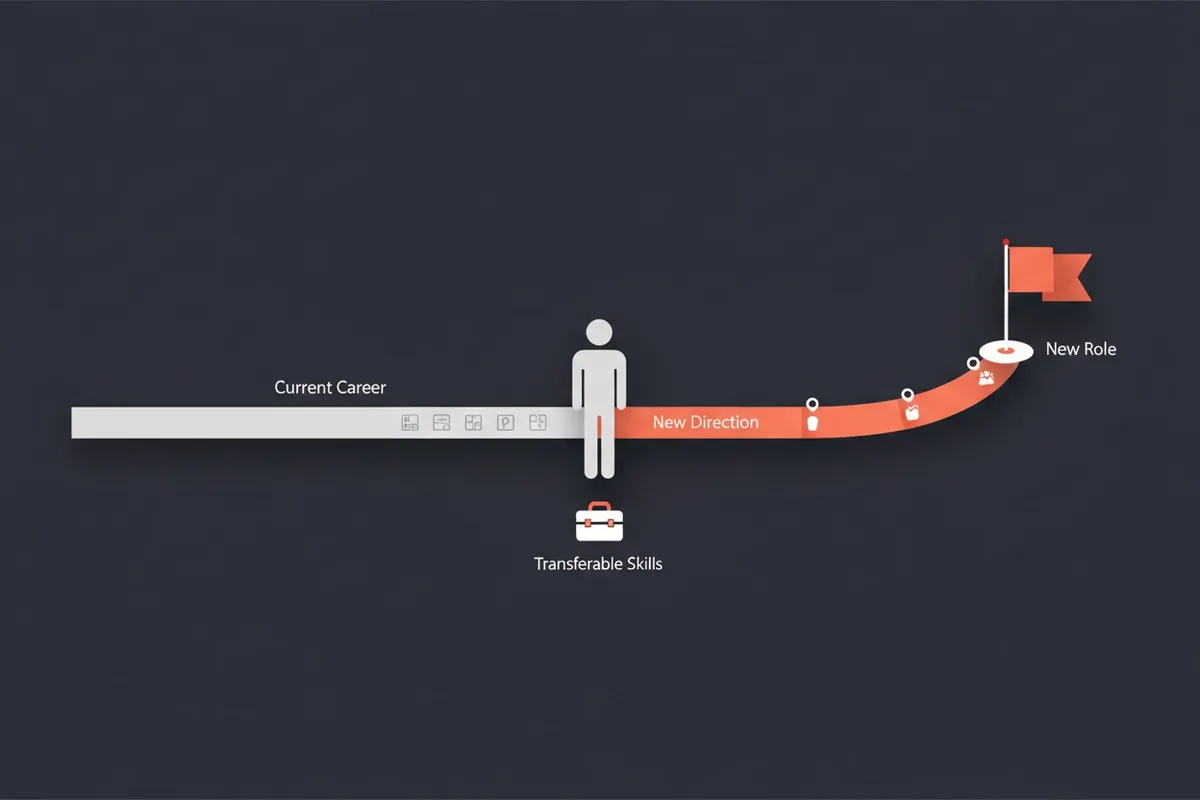
Transferable skills are the reason a former teacher lands a corporate training role in 90 days, or a retail manager walks into an operations position at a tech startup. They are also the reason most career changers underestimate themselves: because these skills are invisible when you are still looking at your old job title instead of what you actually did each day. Understanding your transferable skills for a career change is not a feel-good exercise. It is the practical foundation for every resume, cover letter, and interview conversation you will have in a new field.
What Transferable Skills Actually Are
A transferable skill is any ability you have built in one context that delivers value in a different context. That definition is deceptively simple. The confusion comes from two common mistakes.
The first mistake is conflating transferable skills with job-specific technical knowledge. Knowing how to operate a specific point-of-sale system is not transferable. The ability to train a team of fifteen people on a new system, track adoption rates, and course-correct when uptake stalls. That is transferable. One is a tool; the other is a capability.
The second mistake is thinking transferable skills are only "soft skills." Communication and teamwork matter, but so does knowing how to read a financial model, run a SQL query, write a tight project brief, or facilitate a structured negotiation. The World Economic Forum's Future of Jobs Report 2025 found that analytical thinking is the single most sought-after skill among employers globally, seven out of ten companies call it essential. Analytical thinking is not soft. It is also not industry-specific. It is transferable.
Transferable skills fall into four broad categories:
- Cognitive skills: analytical thinking, problem-solving, critical evaluation, research synthesis
- Communication skills: written and verbal communication, presentation, negotiation, persuasion
- People and leadership skills: managing direct reports, coaching, conflict resolution, cross-functional collaboration
- Self-management skills: resilience, time management, prioritization, independent judgment
Every career changer has a portfolio across these four buckets. The goal is to find yours and name it precisely.
Why Transferable Skills for Career Change Matter More Than Ever
Two structural shifts have made transferable skills the currency of the modern job market.
First, skills-based hiring has become mainstream. According to the National Association of Colleges and Employers (NACE) Job Outlook 2025 Spring Update, nearly two-thirds of employers now use skills-based hiring criteria, meaning they explicitly evaluate whether a candidate demonstrates the abilities a role needs, rather than filtering purely by years in a matching job title. The four-year degree requirement has dropped by more than 30% across middle-skill job postings since 2017, according to research tracked by Apollo Technical. The wall between "you have the right background" and "you don't" has never been lower.
Second, career trajectories have fragmented. Gen Z is projected to hold up to 17 jobs across 7 different careers during their working lives. The average American already changes jobs 12 times. When careers span multiple industries, the skills that travel with you are the only permanent asset you control. Specific job knowledge ages and becomes obsolete; the ability to manage complexity, communicate clearly, and learn quickly compounds.
The WEF report also found that 65% of the skills required in most jobs will shift by 2030. That is not a reason to panic. It is a reason to understand which of your skills are durable and which are perishable.
How to Run a Transferable Skills Audit
You cannot articulate what you cannot see. The audit below forces specificity. Block two hours, work through each step.
Step 1: List every role you have held (including unpaid work)
Go back at least ten years, or to the beginning of your working life if you are early-career. Include internships, volunteer leadership, freelance projects, and significant side work. Each role gets its own section.
Step 2: Break each role into its actual tasks
Do not write job descriptions. Those are what your employer needed on paper. Write what you did on a given Tuesday. Use 15-minute interval thinking: if someone tracked your working day in slots, what would each slot show? Common outputs include:
- Ran weekly team syncs and documented action items
- Reviewed vendor invoices and flagged discrepancies to finance
- Wrote email sequences for customer onboarding campaigns
- Interviewed candidates and compiled evaluation summaries
- Built dashboards in Excel to track monthly sales pipeline
Granularity matters. "Managed clients" is useless. "Managed a portfolio of 40 SMB accounts, conducted quarterly business reviews, and reduced churn by identifying expansion opportunities before renewal" is a transferable skill package.
Step 3: Categorize each task by skill
Take your task list and tag each item. Was this primarily analytical? Communication? Leadership? Self-management? Some tasks involve multiple categories. Tag them all. Patterns will emerge. Someone who consistently flags discrepancies, monitors trends, and synthesizes data from multiple sources has an analytical thinking thread running through their career regardless of industry.
Step 4: Identify your strongest clusters
Look for the categories where you have the most depth, the highest-stakes examples, and quantifiable outcomes. Depth plus evidence is what makes a skill genuinely transferable in a hiring conversation. A skill you can demonstrate once is interesting. A skill you can demonstrate across three different contexts, different teams, different problems, different stakes, is convincing.
Step 5: Match against the target role
Pull three to five job postings in your target field. Highlight every skill or competency mentioned. Now compare to your clusters. The overlap is your transferable skills case. The gap is your development list.
The NIH Office of Intramural Training and Education identifies problem-solving, teamwork, and communication as the top three skills employers seek in 2025, and all three appear in virtually every career, in every industry, in every function. The audit reveals how yours show up and at what level.
Common Transferable Skills Career Changers Overlook
Certain skills get dismissed because they seem ordinary to the person who has them. They are not ordinary to a hiring manager in a field where they are scarce.
Data interpretation. If you have spent years reading reports, spotting anomalies, or translating numbers into decisions, even in a non-analytical-sounding role like sales or operations, you have a skill that many candidates in creative, nonprofit, or early-career fields lack.
Process design. Building a workflow from scratch, documenting an SOP, or systematizing something that was previously improvised is a high-value capability in any growing organization. It shows up in marketing coordinators, store managers, office administrators, and HR generalists, roles that rarely get credit for it.
Managing upward. If your work involved keeping senior stakeholders informed, translating technical problems into business language, or managing expectations under pressure, you have demonstrated executive communication. That is rare enough to mention explicitly.
Hiring and performance feedback. Any experience screening candidates, conducting performance reviews, or coaching underperforming team members is relevant to management tracks in almost any industry.
Budget ownership. Managing even a small budget, tracking spend, requesting resources, justifying variances, signals financial literacy that many individual contributors never develop.
Customer-facing judgment. Handling escalations, managing difficult conversations, or retaining unhappy accounts requires emotional regulation and situational judgment that companies in every sector desperately need.
How to Present Transferable Skills on a Resume
The audit gives you raw material. The resume is where you translate that material into the language of the target field.
Three principles:
Lead with outcomes, not job duties. "Communicated with stakeholders" tells a hiring manager nothing. "Produced weekly briefings for a 12-person executive team, reducing meeting time by 40% through tighter pre-read materials" tells them you can operate at a level of clarity and efficiency they need.
Use the vocabulary of the new field. If your target role calls it "cross-functional collaboration" and you've been calling it "coordinating with other departments," update your language. You are not misrepresenting anything. You are translating accurately, which is exactly what career changers need to do.
Front-load your most transferable sections. A standard reverse-chronological resume buries the skills under the job title that signals the wrong industry. Consider a hybrid format that leads with a skills summary or selected accomplishments section before the work history. This gives hiring managers the transferability proof before they get to the title that might make them hesitate.
If you are applying to roles with structured competency frameworks, common in tech, finance, healthcare administration, and government, research the specific competencies the role uses and map your examples explicitly. Your resume should make that mapping obvious, not implicit.
For role-specific resume examples organized by job type, OfferFlow's resume examples library offers templates built around the skills language each field actually uses.
Transferable Skills in Interviews
The audit and resume work prepares you. The interview is where you prove it.
Use the STAR format (Situation, Task, Action, Result) but adapt it deliberately for career-change conversations. The situation and task will often come from your old field; the key is to make the action and result legible to someone in the new field.
Example: A teacher applying to a corporate learning and development role should not lead with "I taught 11th grade English." They should say: "I designed and delivered curriculum for 28 students with mixed skill levels, assessed comprehension through formative and summative methods, and adjusted pacing based on performance data, resulting in 94% of my students hitting the proficiency benchmark at mid-year." That is instructional design, adult learning principles, and data-driven iteration, the exact language L&D hiring managers use.
Preparation matters. Before each interview, take three to five job description competencies and write out one STAR story per competency. The goal is to walk in with the translation already done.
For roles that include behavioral questions by function, like software engineering interviews or product manager interviews, reviewing common question patterns in the target field helps you anticipate where to deploy your transferable examples.
Building Credibility Alongside Skills
Transferable skills get you the interview. They may not alone get you the offer if you are making a significant industry leap. Two approaches accelerate credibility:
Targeted micro-credentials. A short course, certification, or bootcamp in the target field signals commitment and fills technical gaps that transferable skills cannot cover. The goal is not a full degree. It is one credential that gives the hiring manager permission to take a bet on you.
Adjacent experience. Freelance projects, consulting engagements, volunteer work, or internal cross-functional projects that touch the new field give you examples from the target context. Even a handful of real examples in the new field alongside your transferable skills portfolio substantially closes the credibility gap.
Both of these appear prominently on OfferFlow's career change job tracking board, where you can organize your applications by stage and track which roles are responding to which version of your transferable skills positioning.
The Confidence Problem
Most people undersell their transferable skills not because the skills are weak, but because they have never been forced to articulate them in a new context. The audit above fixes that. So does talking to people already working in your target field, through informational interviews, professional associations, or LinkedIn conversations, because hearing the vocabulary and problems of the new field from the inside teaches you faster than any job description.
Only 16% of workers know exactly how they could apply their skills to a different career path, according to research cited by Careershifters. That number is not a reflection of limited skills. It is a reflection of limited self-examination. The skills exist. The work is making them visible, to yourself first, then to every employer you meet.
For a structured approach to the full career pivot, including how to position a cover letter when you are coming from a different industry, see OfferFlow's guide on cover letters for career changers. And for salary benchmarking in your target role before you negotiate, salary data by role and city gives you the numbers you need to know your worth before the offer comes.
Your skills did not disappear when your industry changed. They are waiting to be named.