It's 11:30pm on a Tuesday. You're scrolling LinkedIn job listings, but you haven't actually clicked into one to read it in twenty minutes. You're not applying. You're not even browsing seriously. You're doing the job-search version of doom-scrolling, and you've been doing it for an hour.
This is burnout. Not the dramatic "I quit" kind. The quieter kind that leaves you spending three hours a day on your job search while accomplishing nothing, then feeling guilty about it, then doing it again tomorrow.
Job search burnout is real, undertreated, and disproportionately hits the most diligent candidates. The ones who've been at it longest, who've sent the most applications, who care the most about doing it right. If three months of search and 80+ applications have left you depleted, it's not a character flaw. It's a predictable response to a brutal process.
This guide covers the five signs to recognize, the 2-week reset that actually breaks the cycle, and the system changes that prevent re-burnout.
The 5 Signs You're in Job Search Burnout
Some of these will sound familiar. The more that do, the further along the cycle you are.
1. Decision fatigue. Even small choices feel impossible. Which job should I apply to first? Which resume version? Which cover letter angle? You sit looking at the screen for 20 minutes and pick none of them. Then you close the laptop.
2. Doom scrolling job boards. You open Indeed or LinkedIn and "look at jobs" without actually applying. Half an hour passes. You haven't tailored anything, written anything, sent anything. You feel like you "worked on your job search."
3. Physical symptoms. Sleep disruption. Appetite changes (either eating more or losing interest in food). Tension headaches. Jaw clenching. The body knows something is wrong before your mind admits it.
4. Cynicism. "This is rigged." "No one's actually hiring." "All these companies are fake." "AI is reading my resume and there's nothing I can do." Cynicism is the mind's defense mechanism against repeated rejection. It pre-empties the disappointment. It also kills your performance in actual interviews.
5. Self-criticism spiral. Every rejection becomes evidence of your inadequacy. "I'm not good enough for this market." "Maybe I picked the wrong career." "Maybe I should just give up and take anything." When rejection, a normal, frequent, statistical part of any job search, feels like personal judgment, you're deep in burnout.
If you recognize three or more of these, this article is for you.
Why Job Search Burnout Hits Differently
Workplace burnout has well-known dynamics: too much load, too little control, recovery during weekends, eventual escape via vacation or quitting. Job search burnout doesn't have those release valves.
A few structural reasons it's worse:
No boundaries. Unlike a job, you "could" be applying right now, always. There's no manager telling you to stop. There's no obvious end of day. The job search exists in every empty moment.
Rejection is the dominant signal. Even strong candidates get rejected from 80–90% of roles they apply to. Most of your feedback is "no" or no response at all. The brain doesn't process this well over time.
No team. Coworker burnout has a shared experience. Job search burnout is solitary. Even friends and family lose patience after the third month.
No produce-or-starve relief. The only way out is to sign an offer. Until that happens, the pressure keeps building. There's no equivalent of "I'll take a week off."
This is why ordinary "take a break" advice fails for job search burnout. You can't really take a break. The search continues to be needed. The recovery plan has to work within that constraint.
The 2-Week Recovery Plan
The plan has two phases: a hard stop, then a calibrated return.
Week 1: Stop, Don't Optimize
The first instinct of a burned-out job seeker is to "be smarter." Optimize the process, try new tactics, fix the strategy. Don't. Optimizing in burnout produces worse decisions.
For days 1–3, fully stop. No applications. No LinkedIn. No job board scrolling. If a recruiter you're already in conversation with messages you, reply briefly, but no new outbound.
This will feel terrifying. You will be convinced you're "falling behind." You're not. Three days of nothing changes nothing in your search trajectory, and the recovery is real.
For days 4–7, light maintenance only. Reply to recruiter messages. Check follow-up dates on existing interviews. Do not apply to anything new.
Use the freed time intentionally. Sleep more than you usually allow. Move your body daily, walk, run, gym, anything. See friends in person. Resume hobbies. Eat real meals. Spend time outside.
Most people protest that "they can't afford a week off." But the prior month produced zero useful output anyway. A week of reset doesn't lose you anything you were getting.
Week 2: Resume With Limits
After a full week of stop, start again, but with hard limits.
- Cap applications at 5 per day. Only to roles you'd actually take if offered. No "spray and pray."
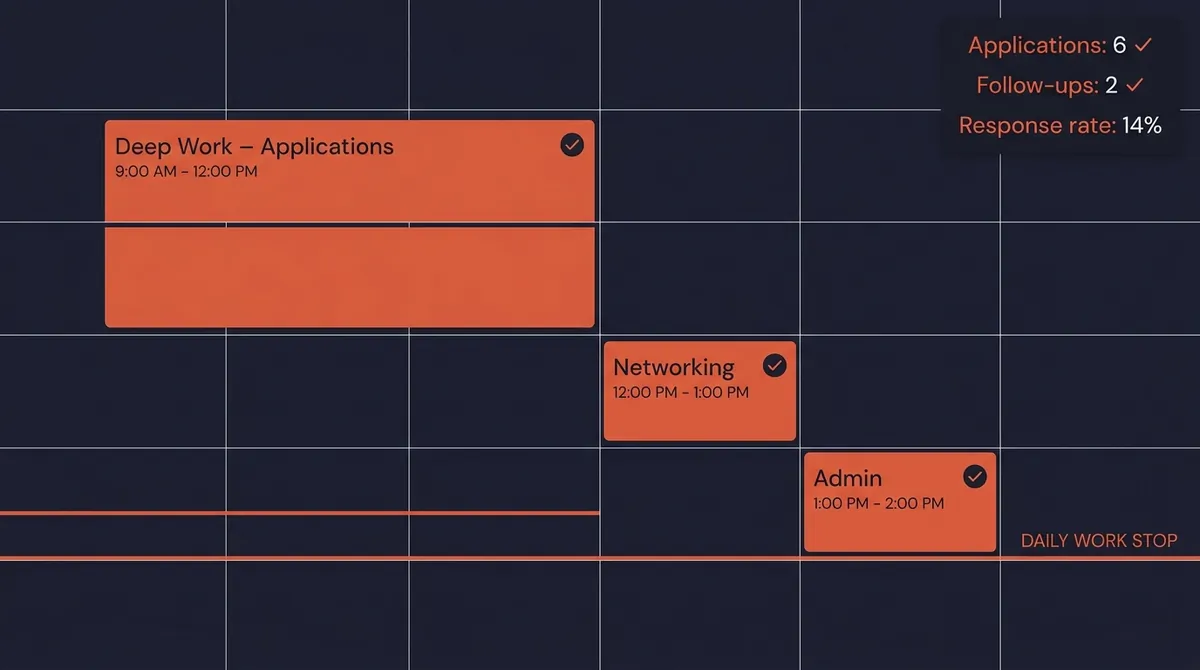
- Cap search time at 2 hours/day. Hard stop at the 2-hour mark.
- Take one full day off per week. Saturday or Sunday, completely unplugged from job search.
These limits will feel constraining if you were applying 20+ per day before. They will produce more interviews, not fewer. Five tailored applications outperform 25 spray-and-pray applications on a 4-to-1 ratio in nearly every recent study.
System Changes That Prevent Re-Burnout
Recovery is short. Maintenance is the longer game.
Set a weekly application cap. 15–20 quality applications per week is the sustainable ceiling. Past that, quality drops and burnout accelerates.
Track outcomes, not effort. Counting applications sent rewards volume. Counting interviews booked rewards quality. Switch the metric you watch.
Stop checking job boards before bed. The combination of light from screens, the stress response triggered by rejection emails, and the doom-scroll pattern destroys sleep quality. No job-search activity after 8pm.
One day completely off per week. No exceptions. Your brain needs the full reset, not just the half-attempt.
For the broader productivity system underneath these limits, see the job search productivity system. For diagnosing whether your search itself (not just your effort) is broken, see the signs your job search is broken.
The Mindset Shift That Actually Helps
Beyond the operational changes, there's a reframe that changes how rejection feels:
You're not "selling yourself." You're filtering for fit. A rejection means you and the role didn't match. That's the recruiter doing their job. It's not a judgment of your worth.
Your job is to generate INTERVIEWS, not OFFERS. You can't control offers. You can control whether you generate interview pipeline. Focus the metric on what you actually influence.
Rejection is statistical, not personal. Even the best candidate in your domain gets rejected from most roles. The companies have constraints you don't see, internal candidates, budget freezes, scope changes. None of those reflect on you.
These aren't motivational posters. They're real reframes that, when internalized, change which signals your brain treats as relevant. Most burnout comes from treating noise as signal.
When to Pause Longer (Or Get Help)
Some signs that you're past garden-variety burnout and need professional support:
- Persistent sleep disruption beyond two weeks
- Loss of pleasure in activities you used to enjoy
- Hopelessness or thoughts of self-harm
- Persistent dread about reopening any job-related task
If any of these apply, talk to a therapist or career counselor. Many therapists specialize in career-related stress; some career coaches are explicitly trained in burnout recovery. This is not a luxury, for a long search, it's basic maintenance.
A Simple Daily Anti-Burnout Routine
Once you're in recovery, the structure that holds the most candidates together:
- Morning: 30-minute walk before opening the laptop. Sets the day. Forces sunlight, movement, no screens.
- Mid-day: lunch away from the computer. Even 20 minutes. No "I'll just check email."
- End: hard stop at 6pm. No more job-search tasks after that.
- Weekly: one full day off, ideally not the same day as your worst rejection emails arrive.
The routine sounds soft. It's load-bearing. Most candidates who can't recover are skipping at least one of these.
Use Decision Fatigue as a Diagnostic
Here's a useful test: when you sit down to "do your job search," how long does it take you to figure out what to do?
A healthy search has clear next actions. Apply to these three roles. Tailor this resume. Send these follow-ups. Five minutes to know what's next.
A burned-out search has paralysis. You stare at the screen. You don't know if you should apply, follow up, tailor, network, or scroll. You can't decide. Decision fatigue is the most reliable burnout sign.
The fix is partly the recovery plan above. The other part is having a system that decides for you. A clear pipeline view (kanban or list) where you can see what stage each application is in eliminates 80% of "what do I do today?" decisions. OfferFlow's daily dashboard surfaces three things automatically: which jobs need follow-up today, which applications are stale, and which interviews are coming up. Removing the decision lifts the burnout. You just do the next thing the system points at.
For the bigger picture of when search burnout overlaps with broader job-search dysfunction, common after layoffs, career pivots, or long employed searches, see what to do after getting laid off and how to job search while employed for the relevant context.
The Realistic Path Forward
Job search burnout doesn't get fixed by trying harder. It gets fixed by trying less, with structure. Five quality applications a day beats twenty exhausted ones. One full day off per week makes the other six productive. A clear system removes decision fatigue.
If you're three months in and stuck, the answer isn't another optimization. It's the reset, followed by limits. Most candidates who recover do so by doing less and protecting what they do.
You're a marathon runner, not a sprinter. Pace matters more than peak speed. The offer comes when your system is sustainable, usually 2–4 weeks after you start running the recovery routine consistently.