You've sent 80 applications. Maybe more. You're getting 2-3 responses, if that. Your resume has been reviewed, rewritten, and optimized. You're applying to the right roles at the right companies. So why isn't it working?
Here's the uncomfortable truth most job seekers don't hear: the problem usually isn't your resume. It's your system. The way you track, follow up, organize, and adapt your job search determines your results more than any single application ever will.
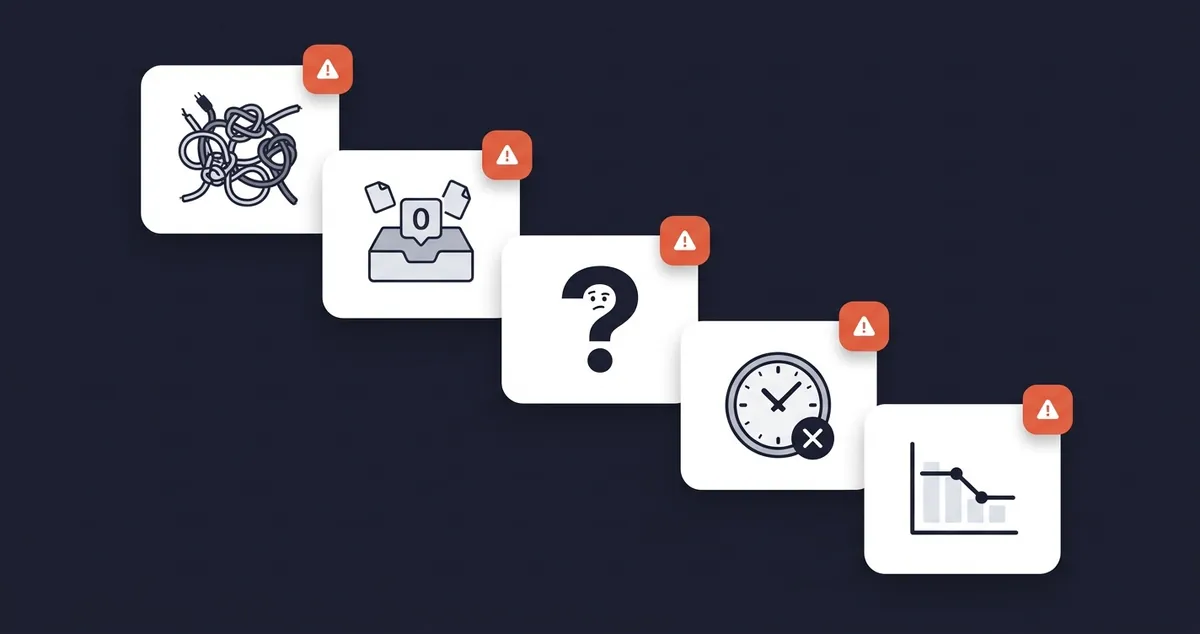
These are the 5 signs that your system, not your qualifications, is holding you back. Each one comes with a specific fix.
Sign 1: You Don't Know Your Response Rate
Ask yourself: out of the last 50 applications you sent, how many got any response? Not an offer, just a response. A screening call. An email. Anything.
If you can't answer that question, you're flying blind.
Your response rate is the single most important metric in a job search. The average sits between 4-8% with no follow-up, and climbs to 11-17% with one or two follow-ups. If your rate is below that, the problem might be targeting (wrong roles or companies). If it's above that but you're not getting interviews, the problem is further down the funnel.
But without tracking this number, you have no way to diagnose the issue. You just keep sending more applications and hoping something sticks.
The fix: Track every application with clear status changes, not just "applied" and "rejected," but every stage in between. Use a tool that automatically calculates your response rate by source. LinkedIn, Indeed, and direct applications don't all perform the same. Knowing which one works for you changes where you spend your time.
Sign 2: You Can't Remember Which Resume You Sent Where
You've created 4 resume versions: one for product management, one for project management, one targeting startups, and your "master" version. A recruiter calls about a role you applied to two weeks ago. You scramble to figure out which version they're looking at.
This happens more often than anyone admits. One Reddit user put it perfectly: "I couldn't remember what I sent, to who, and why I was a fit. Every follow-up email sounded generic, and every recruiter call caught me unprepared."
When you can't connect your resume to the application it belongs to, every conversation starts from zero. You lose the advantage of having tailored your resume in the first place.
The fix: Every time you send a resume, link that specific version to the application. This isn't optional at scale. It's the difference between sounding prepared and sounding generic. A job search CRM does this automatically; a spreadsheet requires discipline that breaks down after 30+ applications.
Sign 3: You Miss Follow-Up Windows
You applied. You waited. You heard nothing. You moved on.
This is the default behavior for most job seekers, and it's one of the most expensive mistakes in job search. The data is clear:
- No follow-up: ~4% response rate
- One follow-up at day 7: ~11% response rate
- Two follow-ups: ~17% response rate
That's a 4x improvement from doing one simple thing, but only if you do it at the right time. And most people don't follow up because they don't track when they applied. By the time they think about it, the window has closed.
Meanwhile, 63% of hiring managers admit to ghosting candidates at some point in the process. Following up is what separates you from the pile of forgotten applications.
The fix: Your system needs to know when you applied and alert you when it's time to follow up. Manual calendar reminders work for 10 applications. At 50+, you need automated follow-up reminders that trigger based on your application timeline, ideally with a draft email ready to send.
Sign 4: You're Repeating Strategies That Don't Work
You've been applying through LinkedIn for 6 weeks. Your response rate from LinkedIn is 2%. Meanwhile, the 5 direct applications you sent to company career pages got you 2 screenings, a 40% response rate.
But you don't know this, because you're not tracking results by source.
Without conversion data, you repeat the same strategy regardless of results. You keep applying the same way, to the same types of roles, through the same channels, because you have no data telling you to change.
This is the job search equivalent of running a marketing campaign with no analytics. You're spending hours on activities that produce nothing, while potentially ignoring the channel that actually works for you.
The fix: Pipeline analytics. Track not just where you applied, but which sources produce responses, screenings, and interviews. Review this data weekly. If LinkedIn isn't working after 30 applications, reduce it. If direct applications have a 5x better response rate, prioritize them. Let data, not habit, drive your job search organization.
Sign 5: You Feel Busy But Not Productive
You're spending 3 hours a day on your job search. You're constantly scrolling job boards, tweaking your resume, researching companies. At the end of the week, you feel exhausted, but you can't point to concrete progress.
This isn't laziness. It's the absence of visible progress signals.
Job search burnout is real, 72% of job seekers report that the process harms their mental health. A major driver of that burnout is the feeling of working hard with nothing to show for it. When your system is a spreadsheet with rows that don't change, every week feels the same.
The fix: A visible pipeline with clear stages creates tangible progress signals. Moving a card from "Applied" to "Screening" feels like progress, because it is. Analytics showing your response rate improving week over week gives you evidence that your efforts are working. Structure creates calm. A kanban board designed for job search isn't just organizational, it's psychological.
The Common Thread: It's Your System, Not Your Resume
All 5 signs point to the same root cause: you're using a tracking-only approach when you need a managed system.
A tracker records what happened. A system helps you decide what to do next.
The difference between a job application tracker and a CRM isn't a matter of features. It's a difference in approach. One stores data. The other drives action.
Your job search is a project. And like any project, it needs a system: clear stages, measurable progress, data-driven decisions, and automated reminders for the things humans forget.
How to Fix Your System Today
You don't need a complete overhaul. Start with these four steps:
Step 1: Set up a pipeline with clear stages (5 minutes). Saved → Applied → Screening → Interview → Offer. Move every application to its actual stage.
Step 2: Link resume versions to each application (ongoing). Every time you send a resume, record which version it was. Your future self will thank you when the recruiter calls.
Step 3: Turn on follow-up reminders (5 minutes). At minimum, set a reminder for day 7 after every application. Ideally, use a system that does this automatically.
Step 4: Review analytics weekly (15 minutes). Every Friday, check: what's my response rate? Which sources are working? Where am I losing opportunities? Adjust next week's strategy based on data.
OfferFlow was built to solve all 5 of these problems, pipeline analytics, resume version linking, smart follow-ups, contact management, and visible progress tracking. Try it free for 7 days, no credit card required.