You can paste a job description into ChatGPT and have a cover letter in 12 seconds. The question isn't whether AI can write one. It can. The question is whether what it produces is good enough that a recruiter will read past the first sentence.
The answer, after testing six different AI cover letter tools against the same posting, is: it depends entirely on how you use them. The best AI cover letter is one that took you 8 minutes total. Generated, edited, sent. The worst is one that took 12 seconds and got auto-filtered because it sounded like every other AI cover letter in the recruiter's inbox.
This is the honest 2026 comparison: what AI tools actually do well, where they fall flat, and how to use them so you save 80% of the writing time without sacrificing reply rate.
How AI Cover Letter Tools Actually Work
Every AI cover letter generator does roughly the same thing under the hood:
- Takes your input (resume or profile, job description, prompt instructions)
- Sends it to a large language model (GPT-4, Claude, Gemini)
- Returns generated text matching a cover letter structure
The differences between tools come down to three things: how much context they automatically include, how good their underlying prompts are, and whether they integrate with the rest of your job search workflow.
A generic prompt to ChatGPT, "Write a cover letter for this job", produces generic output because the model has no context about your specific wins, your tone, or the exact phrasing in the job posting that matters. Dedicated tools pre-load all that context, which is why they often beat naked ChatGPT for the same effort.
The Tools We Tested
Generic LLMs (ChatGPT, Claude, Gemini)
Pros: Free or near-free. Maximum control over prompt. Easy to iterate on tone.
Cons: Requires you to manually paste resume, job description, and write a careful prompt every single time. Easy to under-prompt and get bland output. No memory of your past applications.
Verdict: Best for one-off applications where you have 20 minutes to craft a good prompt. Bad for high-volume search where you're writing 5+ cover letters a week.
Dedicated AI Cover Letter Tools
These are standalone subscription tools focused specifically on cover letters. Examples include CoverDoc.ai, Kickresume's cover letter AI, and various Chrome extensions.
Pros: Pre-built prompts tuned for cover letters. Often store your profile so you don't re-paste your resume each time.
Cons: Standalone. They don't know about the rest of your job search. Subscription cost adds up. Less control over voice than a careful ChatGPT prompt.
Verdict: Reasonable middle ground if you don't already use an integrated platform.
Integrated Job Search Platforms
These are the platforms (Teal, Huntr, Careerflow, OfferFlow) that include AI cover letters as one feature inside a broader job tracking and resume tool.
Pros: The AI has full context, the specific saved job, your resume, sometimes prior cover letters. Output is consistently sharper than generic LLMs because the prompt has more to work with.
Cons: Locked into one platform. Free tier limits how many you can generate.
Verdict: Best workflow if you're tracking jobs in any platform already.
5 Quality Criteria for AI-Generated Cover Letters
When you read AI output before sending it, run through these checks:
Specificity. Does it reference a real detail from the job posting, a product, team, recent announcement? If it's interchangeable with any other company's cover letter, rewrite.
Voice. Does it sound like a person? Watch for AI tells: "passionate about," "deeply excited," "leveraging my skills." Real people don't talk like this. Cut them.
Proof. Does it cite one concrete win with a number, or just adjectives? AI loves "demonstrated strong leadership", replace with "led a team of 6 through a Q3 product launch."
Length. Is the output under 350 words? AI tools tend toward over-padding. Cut ruthlessly.
Adaptability. Is the output usable as a 5-minute edit, or does it need a full rewrite? If it's a rewrite, the tool isn't worth the time.
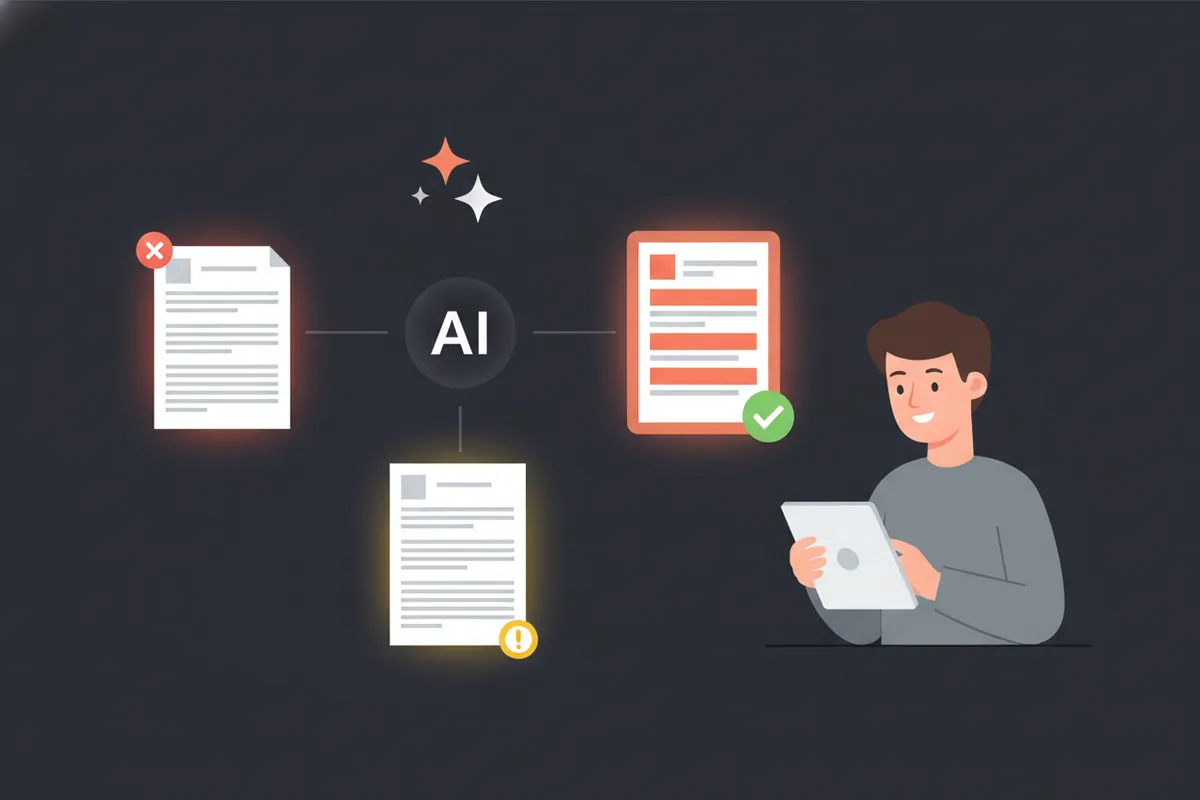
A good AI tool gets you to ~80% on the first generation. The remaining 20% is your edit pass.
Sample Output Comparison
We fed the same job posting (a Senior Product Manager role at a fintech company) and resume to three different AI setups:
Generic ChatGPT, un-prompted:
"I am writing to express my strong interest in the Senior Product Manager position. I am passionate about fintech and believe my skills in product management, cross-functional leadership, and data-driven decision making would be a great fit for your team."
This output gets deleted before paragraph 2. Generic, no specifics, full of cliché.
ChatGPT with a careful 200-word prompt:
"Your launch of the merchant analytics platform last quarter is exactly the category of work I've been doing at scale, and the reason I'm applying for the Senior PM role. At [X Company], I led the analytics product rebuild that took adoption from 22% to 71% in six months..."
Better. Specific, has a metric. This required 5 minutes of prompt engineering plus a 5-minute edit.
Integrated platform with saved job context:
"Your Q3 launch of [product name] caught my attention because I led a parallel buildout at [my company] last year. The biggest unlock for us was an in-app onboarding sequence based on user interviews, adoption jumped from 22% to 71% in two quarters..."
Comparable quality to the careful prompt, but it took 30 seconds because the platform already knew the job, the company, and my resume. This is where integrated tools win on time.
When NOT to Use AI for Cover Letters
A few cases where AI generation will hurt you:
- Highly creative roles. Writers, designers, brand marketers. They will recognize AI patterns instantly. Write these by hand.
- Internal referrals. When someone is putting their name on you, your voice needs to come through. AI flattens that.
- Small companies where the founder hires. They're reading every word. Generic AI output reads like spam to them.
- C-level or VP roles. Hiring committees expect bespoke writing. AI is a starting point, not a sending point.
For most other roles, Senior IC, mid-level management, technical specialist, AI cover letters edited carefully are indistinguishable from fully hand-written ones.
How to Edit AI Output Before Sending
Always edit. Even great AI output has tells. Spend 5 minutes doing this:
- **Delete every "passionate," "excited," "deeply." ** These are AI tell-words.
- Replace one paragraph with a personal-voice story. A specific moment, a specific person, a specific outcome.
- Verify every fact. AI hallucinates titles, dates, company names. Read line by line.
- Read it out loud. If it sounds like a brochure, rewrite the sentence.
- Check for "thread of fit": does each paragraph clearly map to a requirement in the job posting? If not, replace.
This pass takes 5 minutes. It's the difference between a reply and a delete.
The Practical Workflow
The AI workflow that actually wins for cover letters in 2026:
- Save the job to your tracker (1 minute)
- Click "Generate cover letter" with full job + resume context (30 seconds)
- Edit the output: cut clichés, add one personal story, verify facts (5 minutes)
- Send (1 minute)
Total: under 8 minutes per cover letter. Old workflow: 30+ minutes. The compounding effect across a job search is real. 50 applications times 22 saved minutes is 18 hours of your life back.
If you want a deeper dive on the cover letter structure that AI should follow, see how to write a cover letter that gets read. For the broader picture of how AI is reshaping job search in 2026, see how AI is changing job search in 2026. And if you're still relying on spray-and-pray applications without a real system, the signs your job search is broken covers the symptoms.
The Honest Take
AI cover letter tools are real time-savers if you treat them as draft engines. They're time-wasters if you treat them as send-as-is generators. The recruiter at the other end will know, within one sentence, which way you went.
The best tool is the one that gives the AI the most context with the least effort from you. If you're already saving jobs and storing resumes in one place, integrated platforms (OfferFlow includes AI cover letter generation in the free tier) cut the workflow down to seconds because they already know what they need. If you're juggling separate tools, ChatGPT with a careful prompt works, just budget the prompt time.
Either way, never skip the 5-minute edit. That's where AI cover letters become send-worthy.