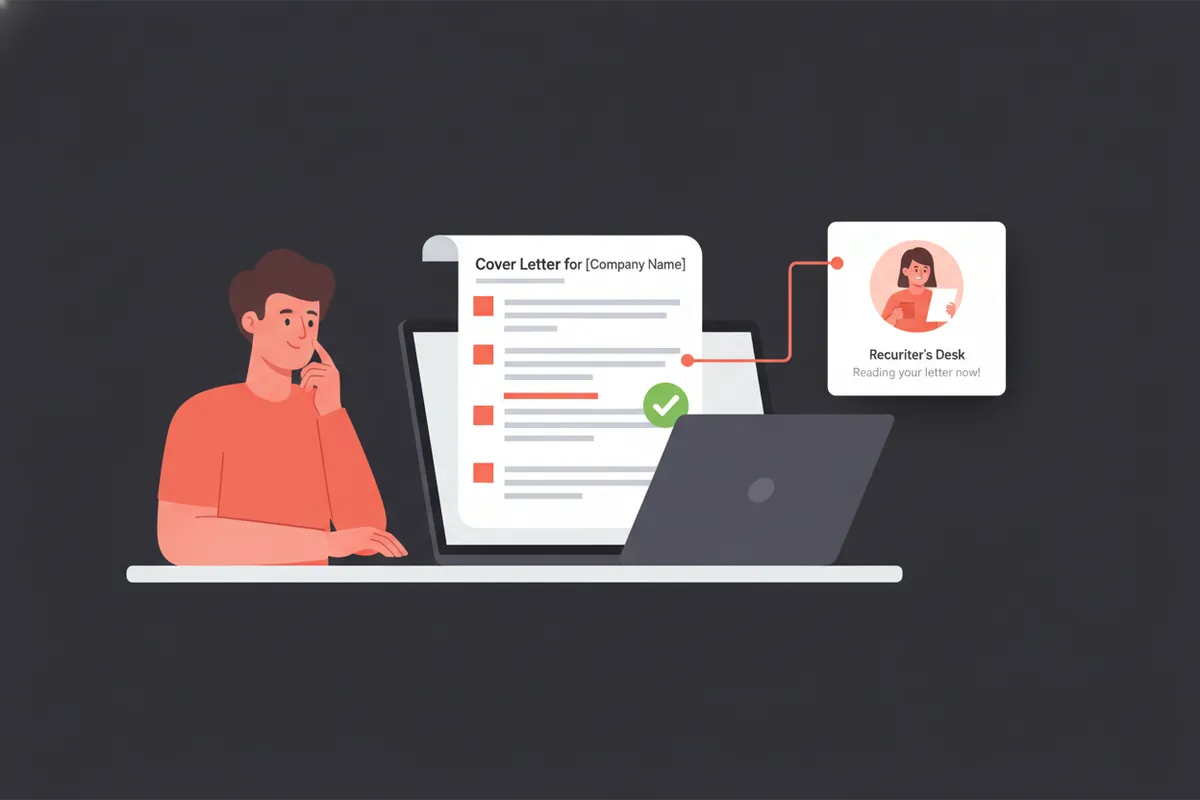
You spent 40 minutes writing a cover letter last Tuesday. The hiring manager spent 8 seconds reading it before clicking past to your resume, and that was if they opened it at all.
This isn't a reason to give up on cover letters. It's a reason to write them like someone who knows how 8 seconds will be spent.
In 2026, cover letters still matter for about a quarter of roles. They matter more for mid-senior positions, career pivots, and smaller companies where founders or hiring managers read every application themselves. The difference between a cover letter that gets you an interview and one that gets you skipped isn't length, eloquence, or how much you "love" the company. It's whether the first paragraph proves you actually understand the role.
This guide gives you a 3-paragraph framework you can use for any role, the 5 mistakes that kill cover letters automatically, and a way to write them in under 15 minutes once you have a template.
Do Cover Letters Even Matter Anymore?
Surveys consistently show 24–28% of recruiters say cover letters factor into their decision. That's not most recruiters, but it's enough that skipping is risky on the roles that matter most to you.
More importantly, cover letters disproportionately help certain candidates:
- Career changers: your resume looks wrong for the role; the cover letter explains why you're actually right
- Mid-senior candidates: at this level, hiring managers expect you to articulate fit, not just list jobs
- Applicants to small companies: the founder or hiring manager probably reads every cover letter
- Anyone with a story to explain: gaps, recent layoffs, niche transitions
If you're applying to a Fortune 500 entry-level role through Workday, you can probably skip. For everything else, write one.
The 3-Paragraph Framework
Forget the 5-paragraph college essay structure. A cover letter is closer to a focused pitch: hook, proof, close.
Paragraph 1: The Hook (Why This Role, Specifically)
The first paragraph decides whether you get a second one. Most cover letters open with some variation of:
"I'm writing to apply for the Senior Product Manager role at Acme. I'm passionate about your mission and believe my skills would be a great fit."
This says nothing a thousand other applicants didn't also say. Replace it with one specific reason this company, this team, this role.
"Your Q3 launch of the Acme Insights dashboard solved a problem I've been working on at a smaller scale for the last two years, and I want to help you make it the category standard. That's why I'm applying for the Senior Product Manager role."
The specificity does the work. You read their blog. You looked at the product. You're not spraying applications.
If you can't find anything specific to say, you probably shouldn't be applying.
Paragraph 2: The Proof (One Concrete Win)
The second paragraph proves you can do the job by pointing to one win that maps directly to a top requirement in the listing.
Don't summarize your whole resume. Pick the single most relevant achievement and tell the mini-story:
"At [Previous Company], I led the rollout of a similar analytics product to 12,000 internal users. Adoption hit 78% in the first quarter, double our target, because we built a 30-day onboarding sequence based on actual user interviews instead of assumptions. That same playbook is what I'd bring to your scaling phase."
Notice what's there: one concrete situation, one specific action, one measurable result. Notice what's not: adjectives, "team player," "passionate."
If your achievement doesn't have a number, find one. "Reduced our incident response time" is forgettable. "Cut incident response time from 14 minutes to 3" is memorable.
Paragraph 3: The Close (Specific Next Step)
The closing paragraph isn't a place to beg. It's where you signal you've thought about what you'd do in the role.
"I'd love to walk through how I'd approach the first 90 days on your team, particularly the European market expansion you mentioned in your last earnings call. Are you available for a brief conversation next week?"
That's it. No "thank you for your consideration." No "I look forward to hearing from you." Just one clear forward step.
Cover Letter Format Essentials
A few mechanical things that catch a lot of people:
- Length: 250–350 words. Anything longer gets skipped. If your draft is 500 words, cut the second-best example.
- Address by name when possible: 2 minutes on LinkedIn finds the hiring manager 80% of the time. Use "Hi Sarah" not "Dear Hiring Manager."
- Match your resume header: same name, font, contact line. Looks like one package, not two random documents.
- One page maximum. Recruiters open it on a phone. Two pages won't load before they swipe past.
5 Mistakes That Kill Cover Letters
Restating your resume word-for-word. They have the resume. The cover letter is for context the resume can't give.
The generic opening. "I am writing to apply for the role of X at Y", banned. Lead with something only you'd write.
Talking about what you want, not what they need. "This role would be a great fit for my career goals" is the wrong frame. Their goal is filling the role with someone effective. Talk about that.
Sending the same template to 30 companies. Tailoring is the entire point. The same logic applies to resumes, see how to tailor your resume for each job.
Typos in the company name. The same paragraph that talks about your attention to detail had a typo two lines up. This still happens daily.
When to Skip the Cover Letter
A short list:
- The application explicitly says "optional" AND there's no upload field
- A recruiter messaged you directly and asked for your resume. They're already sold
- An internal employee referred you with a strong introduction
- The role is high-volume entry-level at a Fortune 500 (won't be read)
When in doubt, write one. The downside of writing an extra cover letter is 15 minutes. The downside of skipping a required one is rejection.
Speeding Up Cover Letter Writing
The first cover letter for a new role takes 20–30 minutes. The fifteenth takes 5. Build a system:
Build a "brag file": a single document with 10 of your best concrete wins, each with a metric. When you need a proof paragraph, you copy from this file and edit. No more starting from blank.
Use AI as a draft engine, never a final. Modern AI can produce a credible first draft in 30 seconds. Then you spend 5 minutes editing it to sound like a human. See AI cover letter generators: what works and what doesn't for the full comparison. For the broader playbook, see how AI is changing job search in 2026.
Keep a base template per role type. PM cover letters share 60% of structure. So do engineering, design, marketing letters. Maintain 2–3 base templates and customize the rest.
After 10 cover letters, the system pays for itself for the rest of your search.
Putting It Together
A great cover letter does three things in three short paragraphs: shows you understand THIS role, proves you can do it with ONE concrete result, and ends with a specific next step. That's it. 300 words. Done.
If you're already saving and tailoring jobs in a search tracker, you have the raw material, every company, every role, every job description in one place. OfferFlow's AI Cover Letter feature uses your saved job and resume to draft that 3-paragraph structure in seconds. You spend the 5 minutes you saved making it sound like you.
Most candidates write generic letters because they've never seen what a tailored one does to a hiring manager's response rate. Try the 3-paragraph framework on your next application and watch the reply rate change.