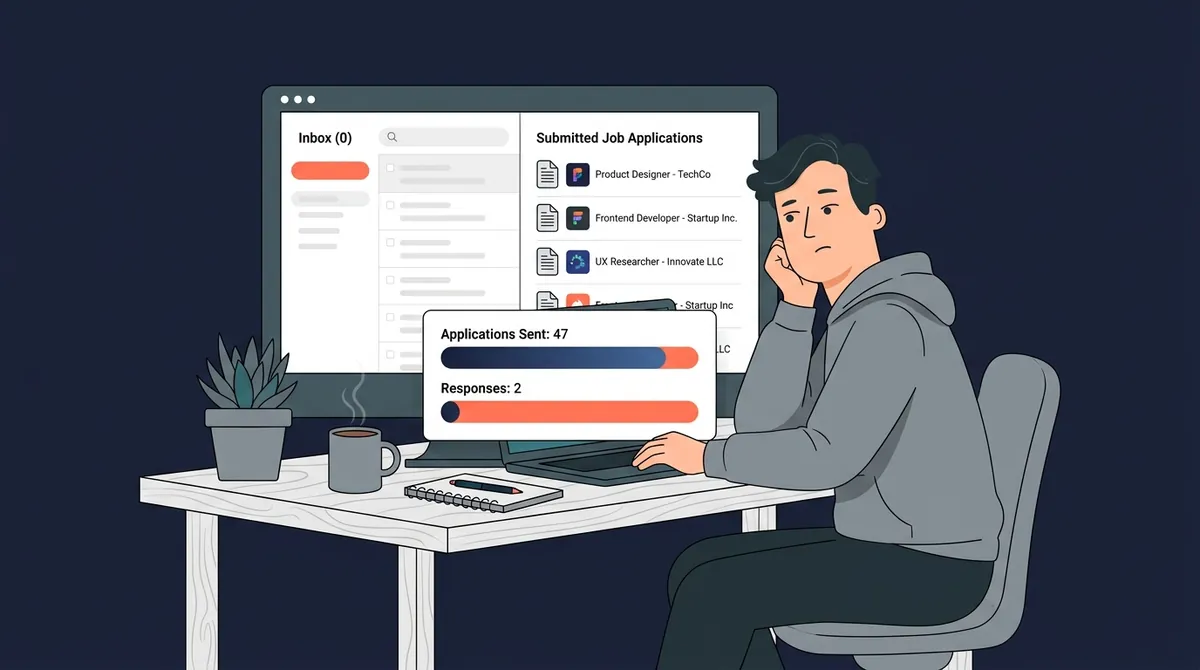
You've sent 50 applications. You've heard back from 2. The silence is deafening, and it's easy to spiral into self-doubt or blame the job market entirely.
Here's the truth: the job market is competitive, but most of the reasons people don't get interviews are fixable. And once you know which one applies to you, you can stop repeating the same approach and start getting results.
This guide covers the 12 most common reasons job seekers don't get interview callbacks, and exactly what to do about each one.
Before We Diagnose: Understanding the Job Search Funnel
The first thing to clarify is where in the process things are breaking down. There's a difference between:
- No responses at all: your application isn't getting through, or isn't compelling enough to act on
- Responses but no interviews: you're passing the first filter but not the second
- Interviews but no offers: a different problem entirely
This article focuses on the most painful scenario: applying and hearing nothing.
A healthy application-to-response rate is roughly 10–20%. If you've sent 30+ tailored applications and heard back from fewer than 3, something specific is going wrong. Let's figure out what.
Resume Problems
Reason 1: Your Resume Is Getting Filtered by ATS Before a Human Sees It
Most mid-to-large companies use Applicant Tracking Systems (ATS) to manage incoming applications. These systems parse your resume, extract information, and score it against the job description, before any human touches it.
If your resume is formatted incorrectly, the parser may misread or skip entire sections. Common ATS killers:
- Text in tables or text boxes (often invisible to parsers)
- Headers and contact info in the document header/footer section
- Columns (ATS often reads left-to-right and merges them into nonsense)
- Non-standard section names ("Where I've Worked" instead of "Experience")
- Complex design elements: icons, graphics, colored sidebars
The fix: Use a clean, single-column format. Standard section headings. Submitted as .docx or .pdf (check the job posting preference). Then run it through a free ATS checker like Jobscan to see how it scores against specific job descriptions.
Reason 2: Your Resume Isn't Tailored to the Role
A generic resume that lists everything you've ever done reads as unfocused to both ATS and humans. ATS scores keyword match rates against the job description, a generic resume covers every keyword weakly instead of matching the specific role strongly.
The fix: Tailor the top third of your resume for each application, specifically the professional summary and the first 3–4 bullets of your most recent relevant role. This doesn't mean a full rewrite each time. Start with a "master resume" that contains every experience and bullet variant, then pull the most relevant content for each role. Total time per application: 15–20 minutes.
Reason 3: Your Professional Summary Is Weak or Missing
Recruiters spend approximately 6 seconds on the first pass of a resume. The professional summary is the one section positioned to make them slow down.
"Results-driven professional with 5+ years of experience seeking a challenging role" helps no one. It says nothing memorable and matches everything loosely.
The fix: Write a 3-sentence summary using this formula:
- Who you are: your job title and years of experience in the relevant domain
- What you've done: your strongest result, quantified
- What you're targeting: the type of role and what you want to bring to it
Example: "Product Manager with 6 years building B2B SaaS products. Led the launch of 3 features that collectively grew ARR by $2.4M. Seeking a senior PM role at a growth-stage company focused on developer tools."
Reason 4: No Quantification
"Managed social media accounts" is forgettable. "Grew Instagram engagement by 140% in 6 months, increasing qualified leads by 30%" is not.
Numbers create credibility and make your experience concrete. Most job seekers have quantifiable results they haven't thought to include.
The fix: Go through every bullet point and ask: How many? How much? What changed as a result? Even rough figures ("~$500K in pipeline," "team of 6") are better than none.
Application Strategy Problems
Reason 5: You're Targeting the Wrong Roles
Two failure modes here:
Overshooting: Applying to roles 2+ levels above your experience. Your application gets filtered out immediately, not because you're not good, but because you're not the right fit for that role.
Undershooting: Applying to roles significantly below your level. You look like you're settling, which raises questions.
The fix: A good target role has about 70–80% of requirements as a genuine match. If you hit fewer than 60%, reconsider. If you hit 100%, you may be underutilizing yourself. Use the job description as a filter, not just a prompt to apply.
Reason 6: You're Using Only One or Two Job Boards
LinkedIn and Indeed generate enormous application volume. Popular roles on LinkedIn can receive 400+ applications within 48 hours. Your resume enters an extremely competitive pool.
Meanwhile, industry-specific job boards often have 10–30 applicants per posting. The quality of competition is similar, but the quantity is dramatically lower.
The fix: Identify 1–2 niche boards for your industry. For tech: Wellfound, Levels.fyi, YC's Work at a Startup. For marketing: MarketingHire, We Work Remotely. For design: Dribbble Jobs, Behance. Apply to those first, then use LinkedIn and Indeed as a volume supplement.
Reason 7: You're Applying Too Late
Most job openings fill within the first 3–5 days of posting. Applications submitted on day 7 are competing against candidates already in screening. The hiring manager has often formed their mental shortlist.
The fix: Set job alerts on every platform you use, configured to deliver new postings daily or in real time. Apply on the day you find the posting, not on a batch day later in the week.
Competition and Market Context
Reason 8: You're in a Flooded Market
Post-layoff periods in specific industries create temporary oversaturation. In 2022–2024, tech layoffs meant thousands of qualified engineers flooded the market simultaneously. The problem wasn't the candidates. It was volume.
The fix: You can't change the market, but you can change your strategy. Double down on networking (referrals bypass the ATS pile entirely). Target companies earlier in their growth cycle, where hiring volume is lower. Consider adjacent industries where your skills transfer.
Reason 9: The Role Was Already Filled Internally
Studies suggest 40–70% of jobs are filled through internal candidates or referrals before the external posting is even created. Some postings are "ghost jobs", listed to build a pipeline, with no active hiring happening.
The fix: Before applying, do a quick LinkedIn search of the company + job title. If someone internal was recently promoted into that role, the posting may be formality. Combine applications with networking. A referral from inside the company can surface your application even when an internal candidate is favored.
Process and Follow-Up Problems
Reason 10: You're Not Following Up
The vast majority of job seekers submit an application and wait. A single well-written follow-up email, sent 5–7 business days after applying, consistently improves callback rates. Most of your competition simply won't do it.
The fix: Build follow-up into your tracking system as a required step, not an optional one. When you log an application, set the follow-up date immediately. The email itself takes 5 minutes to write, keep a template and personalize two lines.
Reason 11: Your Cover Letter Is Generic (or Counterproductive)
"I am excited to apply for the [Position] at [Company]. I believe my skills and experience make me an excellent candidate.". This letter has been read 10,000 times. It filters you to the middle of the pile.
Some hiring managers read cover letters carefully. Others don't read them at all. But a bad cover letter can work against you even if a good one only helps marginally.
The fix: Three paragraphs:
- Why this specific company, not just any company in the space
- One specific result from your past that's directly relevant to their problem
- One concrete thing you want to do in this role
If you can't write paragraph 1 genuinely, reconsider whether this is a company you actually want to work for.
Reason 12: You're Not Tracking What's Working
This is the meta-reason that underlies many of the others. If you're not tracking your applications, you can't see which resume version generates more responses, which job board produces better results, or how your response rate trends week over week.
Without data, you repeat what you've always done and wonder why nothing changes.
The fix: Set up a tracking system, a spreadsheet, a kanban board, or a dedicated tool like OfferFlow. Log every application. Note which resume you sent, where you found the posting, and when you applied. After 30 applications, look at the data. You'll see patterns a gut feeling would never surface.
How to Diagnose Your Specific Problem
Pull your last 20 applications and calculate:
Response rate = (Screening calls + interview invites) / total applications sent
- Below 5%: Resume or ATS formatting problem (Reasons 1–4)
- 5–10%: Application strategy problem (Reasons 5–9)
- Above 10%: You're getting through. The issue is elsewhere
Look for patterns in what got responses vs. what didn't. Same resume, different job boards? Same job title, different company sizes? Often one data point tells you more than weeks of blind applying.
Your Action Plan for This Week
- Stop applying for 48 hours, just audit
- Calculate your response rate from the last 30 applications
- Run your resume through a free ATS checker against 2–3 target job descriptions
- Identify which one of the 12 reasons is most likely your primary blocker
- Make one specific change, not five
- Apply 10 more times with the change, measure the result
One fix applied consistently beats twelve half-measures scattered across your entire process.
Not getting interviews isn't a verdict on your worth as a candidate. It's a signal that something specific in your process needs adjusting. Find the bottleneck, fix it, and measure whether it worked. That's the whole game.